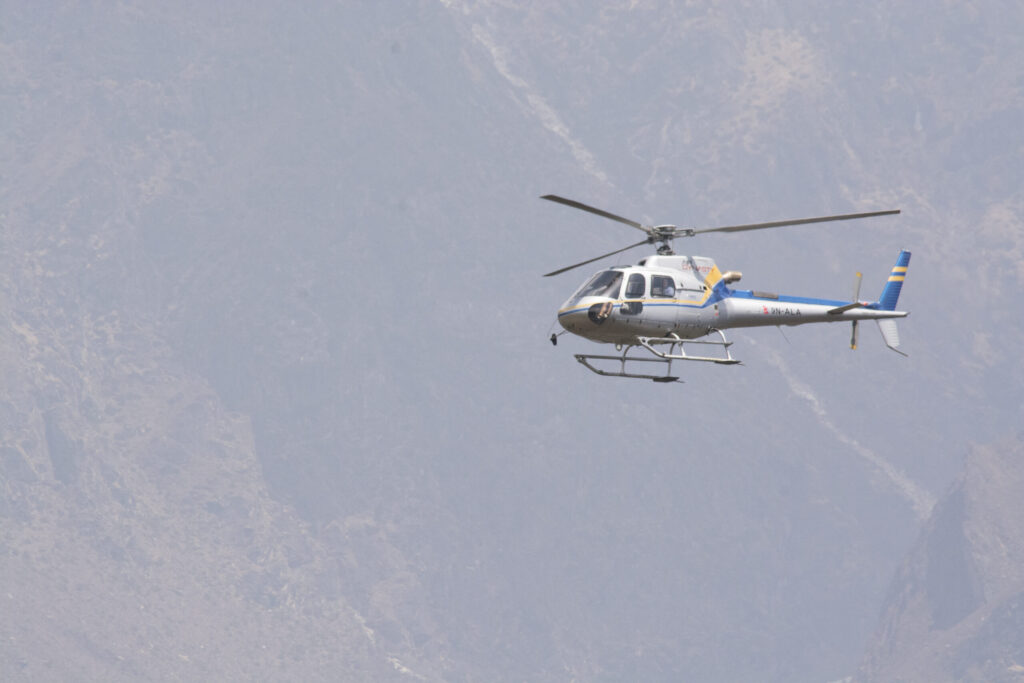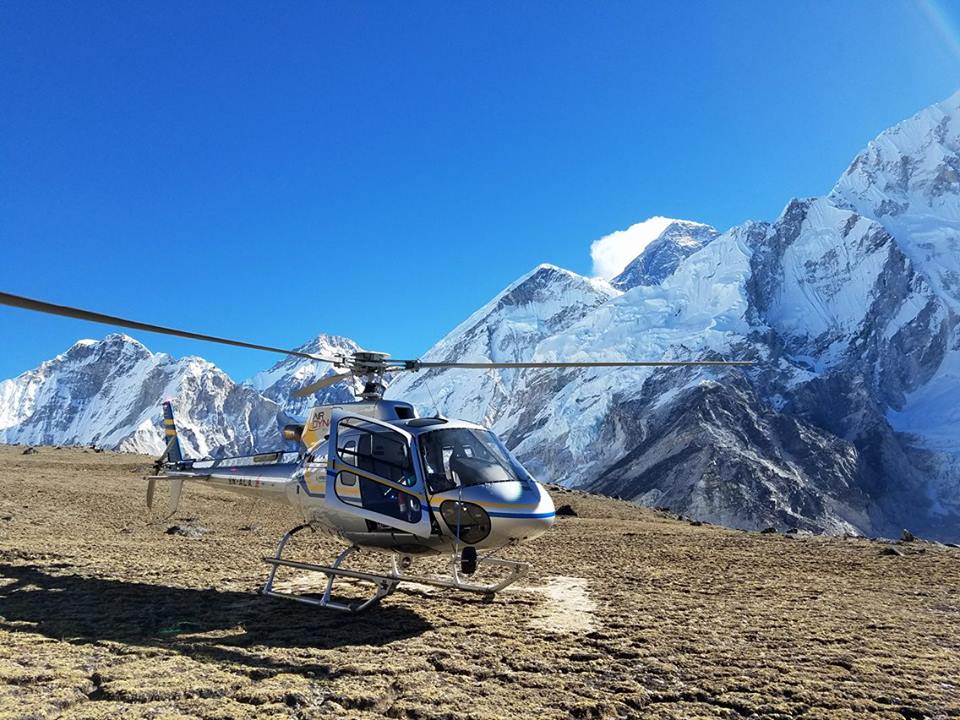
If you’re trekking in the Everest region, the first question about a helicopter is usually practical: Can we fly directly from Kathmandu to Lukla instead of driving to Ramechhap? Often, a Kathmandu–Lukla helicopter transfer can be arranged. But a helicopter is not an all-weather ticket into the mountains, and a shared seat is not quite the same as a confirmed private aircraft.
At Amigo Treks & Expedition, we arrange this route for trekkers, climbers and groups who want to travel between Kathmandu and Lukla. We explain the fare, the total passenger and baggage weight, the flight plan and what happens if the weather changes before accepting a booking. This article covers the Kathmandu–Lukla transfer, not the separate one-day Everest sightseeing helicopter tour or a high-altitude pickup from Gorakshep.
Quick answer (reviewed October 2026): A helicopter from Kathmandu to Lukla generally takes about 40–50 minutes of flying time. Amigo’s currently published indicative price is US$550 per person for a shared seat or approximately US$3,000 for a private charter, with up to five passengers only when the aircraft’s weight and operating limits allow. Availability, actual departure time, final price and baggage allowance must be confirmed for your travel date. All flights depend on the operator and pilot accepting the conditions.
Kathmandu to Lukla Helicopter Flight at a Glance
| Item | Practical information |
|---|---|
| Route | Kathmandu (TIA helicopter operating area) → Tenzing–Hillary Airport, Lukla |
| Flying time | Usually approximately 40–50 minutes, not counting airport reporting or delays |
| Lukla elevation | Approximately 2,846m above sea level |
| Shared seat | Amigo’s published planning price: US$550 per person, subject to a fresh quote |
| Private charter | Amigo’s published planning price: approximately US$3,000 per helicopter |
| Passenger capacity | Often up to five on suitable aircraft, but fewer when aircraft weight/performance calculations require |
| Luggage | No universal guaranteed 15kg rule for every charter; confirm the weight accepted for your flight |
| Main benefit | Can avoid the Kathmandu–Ramechhap road transfer when flying directly |
| Main limitation | Weather, aircraft availability, fuel/route planning, payload and flight safety |
| Booking advice | Ask for written sector, fare, cancellation terms and passenger/baggage weight confirmation |
Kathmandu to Lukla Helicopter Cost: Shared Seat or Charter?
The cost depends on whether you’re reserving one seat or booking the aircraft, and whether the helicopter is positioned for that sector. Prices may also change with fuel, demand, the confirmed landing/airport arrangements and the people and bags carried. The numbers below are Amigo’s published planning rates, not a confirmation that a seat is available on a particular date.
| Booking type | Indicative Amigo rate | What you’re paying for |
|---|---|---|
| Shared Kathmandu → Lukla seat | US$550 per person | One seat on a confirmed shared movement; depends on gathering passengers and safe weight allocation |
| Private Kathmandu → Lukla charter | Approximately US$3,000 per aircraft | Whole aircraft for the contracted sector, subject to its permitted payload |
| Shared Lukla → Kathmandu seat | About US$600 per person in Amigo’s published article | Reverse direction can price differently; confirm the sector separately |
| Private Lukla → Kathmandu charter | Quote required; around US$3,000 is an existing planning reference | Confirm aircraft positioning, passenger count and final rate |
For example, five paying travelers on a US$3,000 private charter would divide the charter cost to US$600 each. That simple division is not a guarantee that five people plus their bags can safely fly together. The operator may need to take fewer passengers, reduce baggage or use an adjusted plan. Also confirm whether airport taxes, ground transfers and any additional positioning legs are included.
For a booking from India, the international visitor’s passport nationality, route, selected service and payment terms determine the final quote; Indian rupees may be discussed using the confirmed exchange basis. We would not advertise an automatic INR price without checking the actual transaction terms. See our Everest Base Camp planning guide for Indian travelers for documents and package choices.
How the Kathmandu to Lukla Helicopter Journey Works
- Before the flight: Amigo confirms your travel date, direction, passenger count and the approximate weight of people and bags.
- Airport reporting: You follow the confirmed operator’s check-in instructions at Kathmandu’s designated helicopter area, with the original identification requested.
- Flying: The crew follows its approved route and decisions based on actual weather, terrain and aircraft performance; a direct journey commonly takes roughly 40–50 minutes.
- Arrival in Lukla: You disembark at the approved airport/landing area, collect accepted bags and meet your trekking guide or local representative.
- Continue trekking: On the standard Everest Base Camp route, the initial walk is toward Phakding (about 2,610m), followed by Namche Bazaar and the high valleys.
We wouldn’t promise a particular mountain or Kathmandu landmark will always be visible from the helicopter. The side you sit on, route choice, visibility and cloud cover affect what you can see. The purpose of this flight is transport to Lukla; it isn’t sold as an aerial Everest Base Camp flyover.
Helicopter from Kathmandu or Plane from Ramechhap?
In the busiest spring and autumn trekking periods, many scheduled fixed-wing Lukla flights operate from Manthali Airport in Ramechhap. That usually means driving from Kathmandu first. Amigo’s standard 15-day Everest Base Camp package includes a private road transfer to Ramechhap, one night there and the published fixed-wing Lukla flight arrangement. A separately booked helicopter from Kathmandu can remove that particular road journey, but it changes the cost and may change the hotel plan.
| Factor | Scheduled fixed-wing via Ramechhap | Kathmandu–Lukla helicopter |
|---|---|---|
| Kathmandu–Ramechhap road travel | Required if the flight operates from Ramechhap | Usually avoided on a direct Kathmandu-origin charter |
| Flying time | Often about 12–20 minutes from Manthali | Typically about 40–50 minutes from Kathmandu |
| How the seat is sold | Airline seat under its ticket conditions | Shared helicopter seat or contracted private aircraft |
| Baggage rules | Airline’s specific free allowance and aircraft limits | Total passenger and luggage weight determined for the helicopter |
| Bad weather | May delay or cancel | May also delay or cancel; not a guaranteed backup |
| Package pricing | Included as specified in the EBC itinerary | Confirm upgrade/supplement, unused-air-ticket handling and any revised transfer charges |
If you already have a fixed-wing ticket in your trekking package and decide to upgrade to a helicopter, ask what happens to that ticket. The airline’s refund conditions, timing and who made the original booking affect the amount, if any, that can be credited. Don’t assume the full value automatically comes off the helicopter fare.
Weather and Lukla Tower Observations: What They Actually Tell Us
Weather is the main operational uncertainty. The pilot must consider conditions not only at Lukla but also over the intended route, the departure and destination areas, available alternatives, visibility, wind and aircraft capability. Helicopters may have different operating characteristics from small fixed-wing planes, but they cannot ignore cloud, terrain, poor visibility or unsafe winds.
Our flight-planning discussions sometimes use short Lukla tower reports. For example, VNLK TWR OBS 0050Z NE/03KTS 10KM SKC VFR represents a report from Lukla at 00:50 UTC (06:35 Nepal time), with northeast wind at three knots, 10km reported visibility and clear-sky/VFR notation. This is an example of how to read the format, not a live observation or evidence that a flight operated.
A single good observation at 06:35 does not tell us whether the route was clear at 07:00, whether a helicopter departed Kathmandu, whether the aircraft had a suitable alternate, or whether a landing was later completed. To calculate actual flight reliability, we’d need time-matched weather observations plus scheduled and completed airline/helicopter movement records, with cancelled and diverted flights accounted for. Amigo’s underlying Viber/tower observation archive has not yet been verified for that analysis, so no historical success rate is quoted here.
The Civil Aviation Authority of Nepal’s Aeronautical Information Publication explains that helicopter landings at certain locations operate under visual-flight rules unless permission is given otherwise. CAAN’s Flight Safety Standards Department publishes operational circulars, including seasonal safety instructions. Such rules and weather reports inform crews; they are not assurances of any particular flight. Our Kathmandu–Lukla flight guide explains the broader cancellation and Ramechhap issues.
Are Helicopter Flights Allowed in the Everest Region in 2026/27?
It’s important to distinguish flying to Lukla from charter landings further up the Khumbu. The local municipality and conservation stakeholders have disputed and restricted some commercial helicopter operations above Lukla, while the national aviation regulator has its own approval authority. These rules have changed and been contested. A travel agency should not assume that a scenic or commercial landing in a higher village is permitted simply because a Kathmandu–Lukla transfer is being sold.
This distinction became public during the 2025 restrictions, described in Kantipur’s reporting on Khumbu commercial helicopter restrictions. Before selling a route beyond Lukla, Amigo checks the current operator and applicable local, park and CAAN requirements. Emergency rescue arrangements are different from ordinary sightseeing or a convenient return flight. A previous press report isn’t a substitute for operational confirmation for your departure date.
Can Five People Fly Together? What About Luggage?
Many helicopters used on this kind of transfer are marketed as carrying up to five passengers plus a pilot. The actual allowable load can be lower because of fuel requirements, altitude, air temperature, wind, aircraft type and the combined weight of people and bags. Those calculations are made by the pilot and operator. We cannot promise that an advertised five-seat capacity will fit five passengers with full trekking duffels.
Please provide realistic passenger and baggage weights before paying. Some operators quote a per-person baggage allowance, but there is no single baggage limit that applies to all helicopter flights. Your confirmed weight allowance should be written on the booking instructions. Excess bags may require storage, a separate transfer or another arrangement that can cost extra. Do not pack for your international airline allowance and assume it will be accepted on the helicopter.
What Happens If the Helicopter Is Delayed or Cancelled?
If the weather doesn’t permit a safe flight, the helicopter may wait, reschedule or cancel. What happens financially depends on the operator, seat agreement, whether aircraft positioning has already occurred and who cancels. We would never promise a full refund or free same-day transfer without seeing the booking terms for that particular flight.
- Ask for a written confirmation stating the aircraft sector, date, route and whether you are buying a shared seat or private charter.
- Check what is included: airport transfers, taxes, baggage, positioning charges and hotel costs in case of delay.
- Ask how weather cancellations, operator cancellations and voluntary cancellations are handled differently.
- Keep the original fixed-wing ticket and its cancellation terms if you are switching from a plane after a delay.
- Leave time before an international flight, and keep flight notices and receipts for any travel-insurance claim.
A helicopter should not be marketed as an emergency medical evacuation just because you want to avoid a long walk or a flight delay. Actual medical rescues require proper coordination with suitable services and, where applicable, the insurer. Read our EBC travel insurance guide to understand medical evacuation and travel-delay coverage separately.
Kathmandu to Lukla Transfer vs Everest Helicopter Tour
These are different products. A Kathmandu–Lukla helicopter transfer takes you to the start of an Everest trek. An Everest helicopter sightseeing tour is a separate itinerary intended to see the higher Everest landscape and return, with its own route, weight limits and landing permissions. The usual sightseeing route may include an overflight rather than landing at Base Camp, and any high-altitude landing is conditional.
Likewise, a Gorakshep to Lukla helicopter pickup is a higher-altitude sector with very different performance, passenger-load and regulatory questions. The Everest Base Camp trek with helicopter return is a trekking itinerary, not just a one-way transfer. Ask us to quote these separately rather than assuming the Kathmandu–Lukla price covers them.
Kathmandu to Lukla Helicopter Flight FAQs
How much is a Kathmandu to Lukla helicopter flight in 2026/27?
Amigo’s published indicative prices are US$550 per person for a shared seat and around US$3,000 for a private charter. These are not real-time rates or seat confirmations; ask for a dated quotation.
How long is the helicopter flight from Kathmandu to Lukla?
Approximately 40–50 minutes in the air on a typical direct routing. Actual timing depends on routing, weather and operating instructions.
Can I fly directly from Kathmandu to Lukla during peak trekking season?
Sometimes, yes, by confirmed helicopter transfer. This can avoid the Ramechhap road journey used by many scheduled planes, but availability, weather and the confirmed fare still matter.
Can I book one seat instead of a whole helicopter?
Yes, Amigo can enquire about shared seats. A seat depends on the operator, safe operating conditions and availability of other passengers; do not assume any particular departure is guaranteed.
How much is a private helicopter for five people?
Amigo’s published planning price is around US$3,000 per aircraft. Five passengers can be carried only when the aircraft’s permitted weight and performance allow it; otherwise fewer may travel.
Is the reverse Lukla to Kathmandu helicopter the same price?
Not necessarily. Amigo’s article has shown around US$600 per shared return seat, but direction, demand and aircraft positioning can change the confirmed price.
What is the baggage limit?
The operator must confirm the allowance for your actual helicopter and combined passenger/baggage weights. A fixed 15kg allowance must not be assumed for all charters.
Will a helicopter fly if Lukla planes are cancelled?
Not automatically. A helicopter may sometimes use a suitable operational window or route, but poor visibility, cloud or wind can also stop helicopter flying.
Can I rely on a VFR Lukla tower observation?
No. The report describes the observed conditions at Lukla at a particular time. It cannot prove that the flight path is safe or that your helicopter has departed or landed.
Where does the helicopter depart in Kathmandu?
From the operator’s confirmed helicopter operating area at Tribhuvan International Airport. Follow the reporting instructions provided with your booking.
Does a Kathmandu to Lukla helicopter land at Everest Base Camp?
No. This transport flight lands at Lukla. Higher Everest sightseeing routes and permitted high-altitude landings are separate services subject to current restrictions and safe operating conditions.
Are commercial helicopters allowed to land above Lukla?
Rules and local restrictions have changed and been disputed. Do not assume a particular higher landing is permitted until the licensed operator confirms the current requirements.
What if I cancel after booking?
Voluntary cancellation terms depend on the actual operator’s written policy, how the seat or aircraft is contracted and any positioning charges. Request the terms before paying.
What if my regular Lukla flight is cancelled?
Ask your airline and trek operator for confirmed status, rebooking and refund conditions. A helicopter may be considered only if safely available and if the extra price and terms are acceptable.
Can Indian travelers pay in INR?
Discuss the confirmed price, exchange basis and accepted payment methods with Amigo. Do not assume all helicopter operators accept INR or that the USD fare converts without fees.
Is the helicopter transfer suitable for Everest Base Camp trekkers?
It can be an alternative way to reach Lukla. It does not shorten or remove the need to acclimatize on the trek, and an arrival at Lukla is not a visit to Everest Base Camp.
Our Advice Before Booking a Lukla Helicopter
A helicopter can save the road transfer to Ramechhap and may suit a small group that wants a direct flight from Kathmandu. It is still a mountain flight. We ask travelers not to make important onward plans based on a supposed guaranteed departure, and not to assume five passengers can take all their trekking bags in one aircraft. The sensible booking is one where the operator, route, price, weight and cancellation arrangements are clear in advance.
If you’re continuing to Base Camp, compare the helicopter sector with Amigo’s 15-day Everest Base Camp trek. Tell us your date, direction of travel, number of passengers and estimated baggage weights. We can then ask the helicopter operator to confirm a suitable arrangement rather than give you an unrealistic promise.