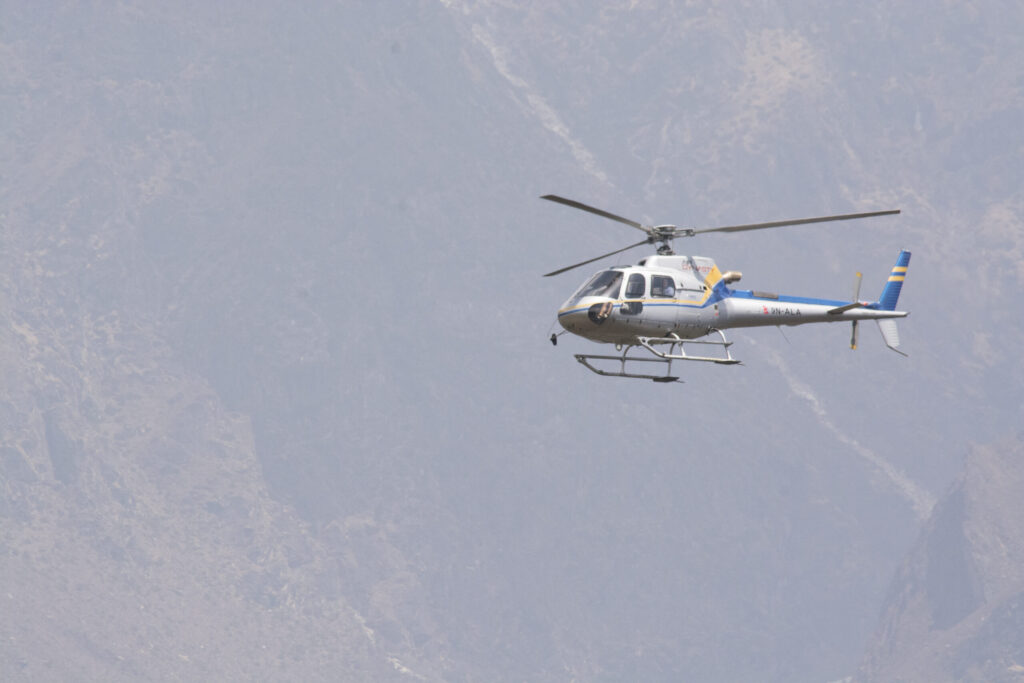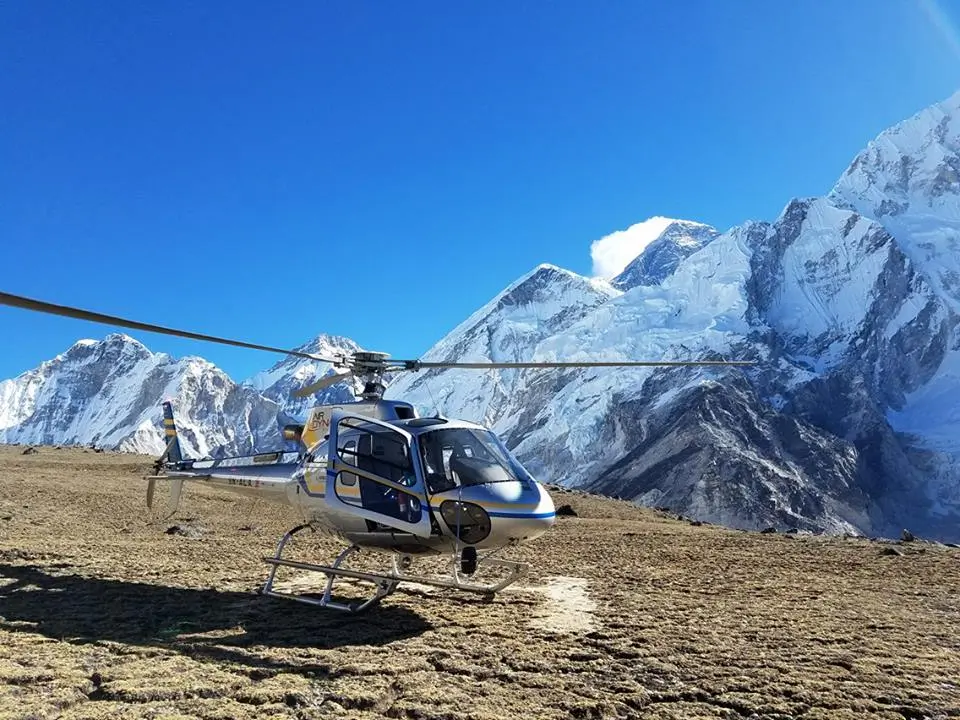
After walking to Everest Base Camp, the return journey is still several days on foot. That is why some trekkers ask us about a helicopter from Gorakshep to Lukla or Kathmandu. The idea is appealing: finish the high part of the trek, avoid retracing the whole trail and return to a lower elevation more quickly. But Gorakshep is over 5,100m, and a pickup there is very different from hiring a helicopter between Kathmandu and Lukla.
At Amigo Treks & Expedition, we discuss three things before treating a high-altitude pickup as part of a booking: whether that type of flight is permitted for the requested date, whether the licensed operator can safely perform it, and what happens if the flight cannot go ahead. We won’t describe a Gorakshep pickup as a guaranteed daily shuttle, and an emergency rescue is not the same service as a pre-arranged sightseeing or trek-return flight.
Quick answer (October 2026 review): Gorakshep is about 5,164m above sea level. A helicopter transfer from there to Lukla or Kathmandu may be discussed, but operators are again offering services in the upper Everest region, but a particular Gorakshep pickup still depends on operator confirmation, landing-site arrangements, weather, aircraft performance and passenger weight. Amigo’s older 2023 article quoted US$1,800–2,300 for Gorakshep–Lukla and US$5,000–5,500 for Gorakshep–Kathmandu private charters. Those are historical figures, not confirmed prices for 2026/27. Request a current, written sector-specific quote before relying on a flight.
Gorakshep Helicopter Transfer: Essential Facts
| Question | What to know |
|---|---|
| Pickup location | Gorakshep area, approximately 5,164m; only if an approved landing site and flight are available |
| Usual trekking context | After visiting Everest Base Camp at about 5,364m and possibly Kala Patthar at about 5,550m |
| Potential destinations | Lukla (~2,846m), Kathmandu (~1,300m), or an approved intermediate transfer point |
| Flight type | Non-emergency private/shared transfer or a separately coordinated medical evacuation |
| Current availability | Helicopter services operate again in parts of the upper Khumbu; confirm the Gorakshep pickup specifically |
| Passenger numbers | Not a guaranteed five-person load; weight, altitude, weather and operator calculations govern |
| Prices | Old 2023 ranges are archived reference figures only; obtain a 2026/27 quotation |
| Weather dependence | All sectors are subject to visibility, wind, en-route weather and safe operations |
| Alternative | Walk down to a lower suitable pickup site, continue the standard trekking route or wait as advised |
Gorakshep to Lukla and Kathmandu Helicopter Cost
Prices found in older Everest articles can be misleading because they often treat a helicopter as a fixed-price taxi. The quotation can change with the season, aircraft and fuel, whether it has to fly in empty to collect passengers, a landing permit, potential intermediate shuttles, available seats and payload limitations. The old prices below are included to explain what Amigo previously advertised, not to offer a bookable service at that amount today.
| Route | Archived Amigo figure (March 2023) | 2026/27 booking position |
|---|---|---|
| Gorakshep → Lukla private charter | US$1,800–2,300 per charter | Fresh operator quote and permission required |
| Gorakshep → Kathmandu private charter | Approximately US$5,000–5,500 per charter | Fresh quote; route may require an intermediate stop or shuttle |
| Shared Gorakshep → Kathmandu seat | Old Amigo pages have listed approximately US$1,300–1,500 per person | No confirmed shared departure or rate; ask about actual seat availability |
| Everest Base Camp or Kala Patthar direct pickup | Old posts have quoted prices for these higher places | Do not assume a normal tourist landing or pickup is currently permitted |
An old price for five passengers doesn’t mean five people can depart Gorakshep together. At that elevation the aircraft may carry substantially fewer people and may need to shuttle individuals to a lower elevation before continuing. If two shuttles are necessary, the total cost and duration can change. We would rather issue one clear written quote after the operator checks your passenger and baggage weights than promise a low price we cannot deliver.
Our Kathmandu to Lukla helicopter guide explains why a transfer between the two main airports has different costs and capacity from a high-altitude Gorakshep pickup. To compare the cost of changing a standard trek to a helicopter-return itinerary, see the Everest Base Camp trek with helicopter return.
Everest Helicopter Operations: What Changed in 2026?
The restriction announced in 2025 should not be treated as an unchanged blanket ban in 2026. Khumbu Pasang Lhamu Rural Municipality announced restrictions on commercial flying above Lukla during 2025, while Sagarmatha National Park, the aviation regulator and helicopter operators took different positions. Some services resumed after the park eased restrictions, even as the local dispute continued. The April 2025 municipal announcement is useful historical context, but should not be quoted as the sole description of the present situation.
In 2026, operators report that helicopter sightseeing services and some high-altitude landings have resumed. September 2026 industry explanations describe shared Kala Patthar landing trips operating again, with smaller passenger shuttles via Pheriche. See the September 2026 operator update and the 2026 passenger shuttle explanation. These are accounts of the services being marketed and operated, not a definitive CAAN authorization document for every landing area.
Gorakshep trek returns, Kala Patthar scenic landings and medical evacuations are different operations. The resumption of one does not automatically authorize every other landing site. For a Gorakshep–Lukla or Gorakshep–Kathmandu transfer, Amigo should confirm the actual pickup site, flight type, operator arrangements, weather, permissible load and any applicable approvals before finalizing the booking. The CAAN Air Transport Department describes its role in authorizing charter and rescue operations.
The practical message is that high-Khumbu helicopter services can be considered again, rather than rejected solely because of the 2025 dispute. But any individual pickup remains conditional on the licensed operator and safe conditions; no itinerary should promise a flight regardless of weather or payload.
Why a Helicopter Can’t Always Carry Five People From Gorakshep
An aircraft may have five passenger seats and still be unable to lift five passengers from a site above 5,000m. Air density decreases with altitude, affecting helicopter performance. Temperature, wind, fuel, luggage, the helipad’s surroundings and the performance of that particular model all matter. A pilot must decide the allowable load and landing/departure procedure; a travel agent cannot override it.
CAAN’s published Flight Operations Requirements for Helicopters classify helipads above 10,000 feet as high-altitude locations for pilot training and authorization. Gorakshep is much higher than that threshold. The relevant pilot qualifications, aircraft performance, oxygen and other operating rules must be met in addition to any local landing permission.
For this reason, the helicopter might first lift a small number of passengers to a lower approved site, then carry a larger group from there. You may hear this described as a shuttle. Whether it is required, where the transfer happens and how many journeys are possible depends on that day’s actual plan. Do not assume Pheriche, Lukla or any other location will be used without confirmation from the operator.
Can a Helicopter Pick You Up at Everest Base Camp or Kala Patthar?
Trekkers sometimes use the phrases “Everest Base Camp helicopter return” and “Gorakshep helicopter return” interchangeably. They are not necessarily the same landing site. On Amigo’s standard 15-day EBC trek, guests walk from Lobuche to Gorakshep, visit Base Camp at about 5,364m on Day 10 and walk back to Gorakshep to sleep. Kala Patthar is normally visited on Day 11, followed by a descent toward Pheriche.
Sightseeing helicopters generally overfly Everest Base Camp rather than land inside the active expedition area. Several operators report that shared Kala Patthar sightseeing landings resumed in 2026 using smaller passenger loads. A Kala Patthar sightseeing landing is not the same as an arranged Gorakshep trekking pickup. The actual landing site and route must be confirmed with the operator, subject to aircraft performance, operating requirements and weather. The exact landing site must be stated in the booking, not vaguely promised as “pick up from Everest Base Camp”.
When Can the Gorakshep Helicopter Operate?
Mountain flying normally depends on a suitable weather window, often in the morning. Conditions can change quickly as cloud develops or wind increases over the ridges and glacier. Even when Lukla is clear, the upper Khumbu can be cloudy or windy. There is no guaranteed good hour or month, and a helicopter is not a reliable escape from a storm.
A short flight at sea level is not a useful comparison for a high-altitude pickup. The travel time to Kathmandu may include a descent, a fuel or passenger transfer stop, or a change in routing. The pilot decides the plan, and the total journey can be longer than the airborne time advertised in old posts. We would provide the confirmed estimated routing and timing with the actual charter quote rather than promise a fixed 55-minute direct flight.
How Amigo Uses Lukla Tower Weather Observations
Amigo has previously used short Lukla tower reports for flight planning. A format example is VNLK TWR OBS 0050Z NE/03KTS 10KM SKC VFR. It means the observation was logged at 00:50 UTC (06:35 Nepal time), with northeast wind reported at 3 knots, visibility of 10km and clear-sky/VFR notation. This is an example report, not a live observation or proof a helicopter flew.
Such a report helps describe the conditions at Lukla at one time. It tells us nothing reliable about cloud over Gorakshep, helipad surface conditions, passenger payload, an aircraft’s position or whether a particular rescue or tourist charter received permission. To derive a real operating or cancellation rate we would need an observation archive matched to scheduled and actual helicopter movements, departures, arrivals, cancellations and diversions. We have not verified those historical operations from Amigo’s observation messages, so we do not publish an invented success percentage.
For wider fixed-wing and helicopter route planning, read our Kathmandu to Lukla flight guide. Air-traffic and weather observations support aviation decisions; the crew and relevant authorities determine whether the flight can take place.
Medical Rescue vs a Non-Emergency Helicopter Return
This is the most important distinction on the page. A medical evacuation is based on the person’s condition and an appropriate medical response. An optional trek-return helicopter is a separate booking with different operating and insurance terms. If someone has serious altitude symptoms, injury or another urgent problem at Gorakshep, notify the guide and seek medical assistance immediately. Do not wait for a sightseeing helicopter to become available.
Headache with nausea, dizziness or marked fatigue after ascent can signal altitude illness. Confusion, inability to walk straight and breathlessness at rest are emergency warning signs. The CDC high-altitude guidance emphasizes stopping ascent when symptoms develop and prompt descent and treatment for severe illness. Weather, permissions, the availability of medical personnel and aircraft performance may affect helicopter rescue; a safe descent and medical response must not depend on a guaranteed pickup.
Tell the guide about symptoms, make contact with the emergency assistance service and insurer where possible, and follow the treating clinician’s or emergency team’s instructions. The local rescue rules and documentation may differ from a leisure booking. Amigo can assist with communications and coordination but cannot guarantee immediate aircraft dispatch.
Insurance, Flight Cancellation and Extra Costs
A high-altitude rescue policy and a travel-delay policy cover different situations. Insurance may pay for a medically necessary evacuation if policy conditions are met, but it generally will not pay for an optional helicopter simply because a trekker is tired of walking. Likewise, a bad-weather delay can create costs for extra meals, hotels and transport without qualifying as a medical emergency.
Check the altitude ceiling and evacuation wording before travel. Gorakshep is above 5,000m and Kala Patthar about 5,550m, so a policy capped at 5,000m is not enough for the whole standard itinerary. Our Everest Base Camp insurance guide explains the questions to ask the insurer.
For an optional charter, get the operator’s terms in writing. Confirm whether the price includes empty-aircraft positioning, permits, an intermediate shuttle, baggage, taxes and any overnight charges if the weather stops the flight. Ask separately about voluntary cancellation, cancellation by the operator, refunds and any charges already incurred. We would not promise a same-day refund or a replacement helicopter before seeing the actual charter agreement.
What We Need Before Quoting a Gorakshep Pickup
- Your preferred pickup date and whether this is an optional return flight or a medical situation.
- The intended departure point and destination, including whether Lukla is acceptable instead of Kathmandu.
- The number of passengers, approximate individual body weights and total bags.
- Any time-sensitive onward flights and how many extra days you have available.
- Whether you already have a fixed-wing return flight and what its refund conditions are.
- Your current altitude and location on the trek, if the request is being made from the trail.
- Confirmation from the licensed operator that the proposed flight type and landing are permitted and feasible.
If you’d like to book a supported helicopter-return trek from the beginning, the Amigo helicopter-return itinerary is the better place to start. It still requires individual departure confirmation and a safe operational plan. If you only want transportation between Kathmandu and Lukla, use the Kathmandu–Lukla helicopter transfer guide instead.
Gorakshep Helicopter Flight: Frequently Asked Questions
Can you fly from Gorakshep to Lukla by helicopter?
Helicopter returns are being offered in the Everest region again, with some high-altitude sightseeing landings reported to have resumed in 2026. For Gorakshep specifically, get written confirmation of the pickup location, helicopter availability, operating arrangements and weight limits.
How much is a Gorakshep to Lukla helicopter flight?
Amigo’s March 2023 article listed US$1,800–2,300 for a charter. That is a historical published range, not a verified 2026/27 price. Request an operator-confirmed quote.
How much is a Gorakshep to Kathmandu helicopter?
The older article quoted approximately US$5,000–5,500 per charter. Routing, permissions, altitude, load and aircraft positioning may change the actual quotation.
Are there shared helicopter seats from Gorakshep?
They should not be assumed. Shared seats depend on a permitted flight, passenger matching, safe load and the licensed operator’s actual schedule. Ask for confirmation rather than relying on old advertisements.
Can five passengers leave Gorakshep in one helicopter?
Not necessarily. Gorakshep’s elevation can sharply limit helicopter payload. A pilot may require fewer passengers or an approved lower-altitude shuttle.
Does the helicopter take off from Everest Base Camp?
A regular tourist pickup directly at Base Camp is not something to promise. Gorakshep, Kala Patthar and Base Camp are different locations, and each possible landing requires separate operational and regulatory confirmation.
Can I return directly to Kathmandu without stopping in Lukla?
An operator may propose a direct or staged route depending on aircraft performance, fuel, permitted sites, weather and passenger weight. The route should be confirmed in writing.
How long does Gorakshep to Kathmandu take?
There is no dependable universal duration. A route may involve repositioning, a fuel stop, shuttle or another transfer; ask the operating company for the planned time.
Are helicopter flights above Lukla banned?
The 2025 local restrictions should not be presented as a permanent blanket ban. Operators report resumed upper-Khumbu activity in 2026, including selected shared Kala Patthar landing tours. Conditions for a Gorakshep trekking pickup must still be confirmed with the licensed operator.
Can I book a Gorakshep helicopter simply because I am tired?
That is an optional non-emergency transfer, not a medical evacuation. It may be arranged through a licensed operator subject to the actual pickup site, aircraft and weather; personal medical insurance may not cover it.
Does a clear Lukla VFR report guarantee a Gorakshep pickup?
No. It reports local conditions at Lukla at one time, not upper-Khumbu conditions, pilot performance calculations, permissions or actual aircraft movements.
Will helicopters fly in bad weather?
Not when conditions fail the operator’s safety requirements. Helicopters may sometimes use different operational windows than fixed-wing aircraft, but they cannot guarantee flying in cloud, wind or poor visibility.
Do I need insurance for a planned helicopter return?
You still need trekking insurance covering medical treatment and rescue at the maximum planned altitude. Optional tourist helicopter transport and weather delays are separate financial risks.
What if a booked helicopter cannot land at Gorakshep?
The operator may suggest waiting, descending to another permitted location, an altered itinerary or cancellation under the agreed terms. Do not assume a guaranteed same-day replacement.
Is medical rescue possible from Gorakshep?
Emergency evacuation may be coordinated where medically justified and permitted, but weather, the patient’s location, available medical support and aircraft conditions can affect timing. Serious symptoms require immediate assistance and an appropriate descent plan.
Should I book the helicopter before starting the trek?
For an optional return flight, discuss it before departure so the itinerary and quotation can be checked, but don’t treat a tentative booking as guaranteed until all permissions, operational details and weather are confirmed.
Our Advice Before You Depend on a Helicopter Return
A helicopter return from the upper Khumbu can save walking days, and services are being offered again in 2026. It remains a conditional service based on a confirmed pickup point, weather and aircraft performance. We advise keeping enough time for the normal descent or a change of pickup point, not booking a tight international flight on the strength of a promised Gorakshep collection. And if someone’s health deteriorates at altitude, the priority is getting appropriate help—not waiting for a convenient tourist charter.
Start with our Everest Base Camp trekking itinerary or helicopter-return option, and send Amigo the dates, number of passengers and approximate weights. We will explain what the licensed operator can confirm and whether a different route is more realistic for your plans.