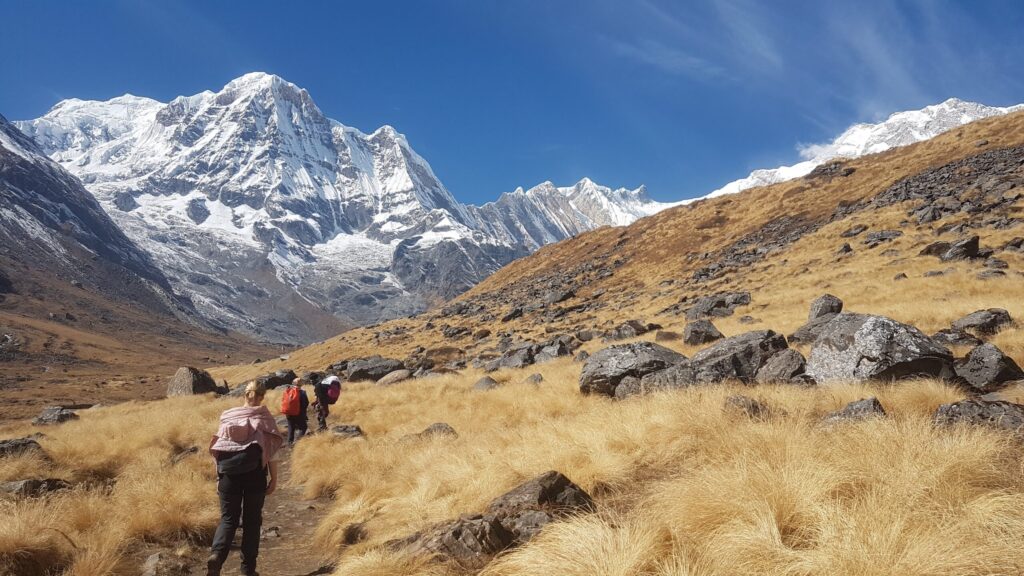
Annapurna Base Camp offers a shorter approach than many classic Nepal treks. Compare the available route lengths, seasonal conditions, and lodge comfort before booking.
Guide type
Nepal planning guide
Best next move
Compare a live itinerary
Updated
July 19, 2026
How to use this guide
Read for clarity first, then move into the right trip format
Read the planning context
Use this page to understand the main tradeoffs, pace, and planning questions around Nepal.
Compare live options
Once the route direction feels clearer, compare live itineraries, durations, and comfort levels.
Ask for route-specific help
Use the planning desk when you need help choosing dates, pacing, private options, or the right final itinerary.
Guide details
Everything You Need To Know About the Annapurna Base Camp Trek in Nepal
55 kilometers long, the Annapurna Conservation Area stretches from north-central to south-central Nepal. This conservation area shields the massif of wild hills.
Experience the beauty and culture that Annapurna Conservation Area has on offer by visiting it while you're in Nepal!
Trekking to Annapurna base camp, also known as the Annapurna Sanctuary Trek, allows trekkers to experience the most spectacular section of this massif, including views of the world's tenth-highest mountain, Annapurna I.
Located north of the beautiful lake city, Pokhara, east of Poon Hill and Ghorepani, and west of Mardi Himal; the Annapurna Base Camp is one of the most popular trekking destinations in Nepal. Every year two-thirds of all trekkers in Nepal visit the Annapurna region.
Some facts related to the Annapurna Base Camp Trek
- Annapurna Base Camp trekking is trekking to the base camp of the Annapurna South.
- Annapurna Base Camp trekking presents trekkers with a chance to view the 10th highest mountain in the world, the Annapurna I.
- The Annapurna Base Camp presents the 3600 panoramas of stunning mountains in the Annapurna region that include, Machhapuchhre (6993m), Annapurna III (7555M), Gangapurna (7454m), Singu Chuli (6501m), Annapurna I (8091m), Annapurna South (7219m) and Hiunchuli (6441m).
- During the Annapurna Base Camp Trek, trekkers can enjoy two base camps – a) Annapurna Base Camp and b) Machhapuchhre Base Camp.
- Trekkers can either go directly to the Annapurna Base Camp or take a detour to Ghorepani- Poon Hill, Ghandrunk or both. Nevertheless, all these trails coincide at Chhomrong and further lead to the base camp.
- If trekkers choose to detour to Ghorepani-Poon Hill, then trekkers can enjoy the second most famous viewpoint after Kala Patthar in the Khumbu region, Poon Hill.
- The view of Machhapuchhre (6993M), Hiunchuli (6441m), Annapurna South (7219m), Baraha Shikhar (FANG) (7647M), Nilgiri South (6839M), Tukuche (6920m) and Dhaulagiri (8167m) are magnificent.
- The entire area is inhabited by people, which offers a great opportunity for trekkers to enjoy unique teahouse trekking.
- During the trekking season, the trail gets very crowded, therefore, this trail is not recommended for trekkers seeking solitude.
Highlights of the Annapurna Base Camp Trekking
The Annapurna Base Camp Trekking is an adventure-filled journey with numerous highlights. The trek starts from the popular Lake City in Nepal, Pokhara, and offers an incredibly diverse landscape, encompassing both high mountain and lowland villages.
During the trek, trekkers are exposed to the unique settlement, lifestyle, culture, tradition, and hospitality of the Gurung, Magar, and Thakali people. The entire area is populated, and trekkers can find guest houses, tea houses, and homestays from beginning to end.
One of the major highlights of the trek is the beautiful sunrise and sunset view of the Annapurna range, Dhaulagiri, and Machhapuchhre from Poon Hill, which is the second most famous viewpoint in Nepal after Kala Patthar in the Khumbu region. The trek offers a perfect blend of subtropical and alpine climates, vegetation, animals, and birds.
Famous Gurung, Magar, and Thakali villages like Ulleri, Ghorepani, and Ghandruk are also part of the trekking route, offering a glimpse into the unique culture and traditions of these ethnic groups. In Ghandruk, trekkers can experience a homestay and visit the Gurung Museum.
After the trek, the Hot Spring in Jhinu Danda serves as a perfect tub to relax tired muscles. Overall, the Annapurna Base Camp Trekking is a perfect blend of breathtaking scenery and an amazing landscape, making it a once-in-a-lifetime experience for trekkers.
The world is a book, and those who do not travel read only the page. – Saint Augustine.
A Day in the Life of an Annapurna Base Camp Trekker
A typical day on the Annapurna Base Camp Trek starts early, with trekkers waking up around 6 am. After a quick breakfast, they set out on the trail, with the goal of reaching the next stop by mid-afternoon. The trek involves several steep climbs and descents, with breaks in between to rest and refuel. Trekkers reach their destination by mid-afternoon, where they check into a tea house or lodge and spend the rest of the day relaxing and exploring the local area. Dinner is usually served around 6-7 pm, after which trekkers retire to bed early to get a good night's rest.
Permits and Costs Required for Annapurna Base Camp Trek
Due to the location of the Annapurna Base Camp within the Annapurna Conservation Area, trekkers must obtain an individual ACAP entry permit.
Trekkers can apply for the permit with two passport-size photographs. The permit fee for SAARC Nationals is NPR 1000/- (Two Hundred only), while for nationals other than SAARC countries is NPR 3,000/- (Three Thousand only).
However, children under the age of 10 do not require any entry fee. This permit is valid for single entry only and must be carried during the entire trip and shown to the concerned person at check posts, upon request.
This permit is non-transferable and non-refundable. Also, this permit only allows trekkers to enter the designated places within the conservation area.
Trekkers must also obtain a Trekkers' Information Management System (TIMS) card to hike to Annapurna Base Camp. Both Free Individual Trekkers (FITs) and those working for government-approved agencies should get TIMS cards.
Trekkers need a copy of their passport and two passport-sized photos and Nepali currency equivalent to NPR 2000/per person
TIMS card can be obtained at the offices of Nepal Tourism Board in Kathmandu and Pokhara and TAAN Secretariat at Maligaon and TAAN Pokhara Secretariat in Pokhara.
The cost of the standard Annapurna Base Camp Trekking packages by Amigo Treks and Expedition also includes the cost of all permits required during the Annapurna Base Camp Treks.
Routes that lead to the Annapurna Base Camp
Starting Pokhara, the standard route, that is, via Ghorepani Poon-Hill requires 11 days to reach the Annapurna Basecamp and come back to Pokhara.
The trail starting Nayapul passes through Birethanti, Ramghai, Sudame, Hille, Tikhedhunga, Ulleri, Banthanti, Ghorepani, Tadapani, Sinuwa, Deurali, and Annapurna Base Camp.
While returning from the Annapurna Base Camp, trekkers will follow the same route down to Chhomrong and then continue to Bamboo, Jinu Danda, and Pothana, where the ABC trek normally ends.
Nevertheless, there is good news for travelers, who cannot spend 10 days getting to the ABC. Most of the companies offer Short Trek to Annapurna Base Camp packages, which allow trekkers to complete the ABC trek in just 10 days.
Typical Annapurna base camp trek itinerary
Day 01: Arrival day
Day 02: Drive from Kathmandu to Pokhara (820m/2,690ft) 200km
Day 03: Drive to Ghandruk (3h) and trek to Chhomrong (2170m/7,119ft) 9 km 5-6h
Day 04: Trek from Chhomrong to Deurali (3230m/10,597ft) 13km 6-7h
Day 05: Trek from Deurali to Annapurna Base Camp (4,130m/13,549ft) 6km 5h
Day 06: Trek from ABC to Bamboo (2310m/7578ft) 12.5km 6-7h
Day 07: Trek from Bamboo to Jhinu (1,780m/5,839ft) 8km 5 hours
Day 08: Trek from Jhinu to Kyumi (6km) 2.5h and drive to Pokhara 2-3h
Day 09: Drive from Pokhara to Kathmandu
Day 10: Departure Day
However, trekkers always have the option of a detour, if they have time and are looking to explore more.
Food and Water during the Annapurna Base Camp Trek
Proper food and water intake is a very essential part of any trekking. Since the Annapurna Base Camp route is entirely inhabited by people, eatery options are more along the trail, compared to the other trekking routes in Nepal. Therefore, the meals served during the trek will be as per the tea house menu.
The standard packages offered by agencies usually include three major meals (breakfast, lunch, dinner) and tea and coffee.
Breakfast: Oatmeal boiled in water, French toast served with jam, honey, or butter, eggs cooked in your preferred style, pancakes, Muesli, or Chapati are available options for breakfast.
Lunch: Usually, traditional Nepali food (Lentil soup, rice, curry, pickle, and meat cooked in Nepali style) is provided for lunch.
The food served is organic, fresh, made using local ingredients, and very tasty. However, if you are looking for some Western food, you can always choose the one provided on the tea house menu.
Dinner: Both traditional and Western food is available for dinner. You can order as per the tea house menu.
Water: You can buy bottled water from the starting point of the trek till the end. But the prices increase, with the increment in altitude. Therefore, using water filters is wiser than buying bottled ones as it reduces your budget as well as the waste on the trek.
Food items such as protein bars, cheese, nuts, chocolates, and other snacks should always be packed. These can be consumed while walking and provide additional calories.
Accommodation during the Annapurna Base Camp Trek
Guesthouses, basic lodges, and tea houses are the available accommodation options during the Annapurna Base Camp Trek. The rooms are very basic with one or two beds and very little or no additional furniture at all.
Some accommodations provide attached bathrooms; however, most offers shared baths and restrooms. Some provide hot shower facilities, however, in the absence of a hot shower facility, trekkers can always ask for a bucket of hot water (extra charge applicable).
The rooms, although very basic, are very comfortable. AC or heater facilities are not available, therefore, it is recommended to bring your sleeping bag.
Moreover, if you are looking to enjoy the local lifestyle and settlement of people, then ask your company to book some of your accommodations on Homestays. This allows you to enjoy the local food, culture, tradition, and lifestyle of local people by spending time with them.
Transportation during the Annapurna Base Camp Trek
Nayapul is the starting point of most of the Annapurna Base Camp Trek. Local transportation (bus) is available from Pokhara to get to Nayapul or you can choose a private vehicle.
It takes about 2 hours to reach Nayapul from Pokhara. However, if you are starting your trip from Kathmandu, you can either drive or fly to Pokhara. If you take a tourist bus from Kathmandu, it takes about 7 hours to reach Pokhara.
However, if you wish to take a flight it will only take about 20-25 mins to reach Pokhara. You can also hire a private jeep or a car to get to Nayapul from Pokhara if you are willing to pay a little extra.
Annapurna Base Camp Difficulty Level
Typically taking 7-12 days to complete, the Annapurna Base Camp trek is generally considered to be of moderate to challenging difficulty. Hikers can expect to trek for 6-7 hours daily, including some steep and strenuous sections, through stunning landscapes like forests, terraced fields, and villages. To successfully complete this trek, one must be in good physical condition, possess a good level of endurance, and properly acclimatize to the high altitudes.
At 4130 meters (13550 feet), the base camp itself is the highest point on the trek. Along the way, travelers will have the opportunity to learn about the culture and way of life of the local Gurung people. Adequate acclimatization is crucial when undertaking this trek, as the high altitudes require a gradual ascent to allow the body to adjust to the lower levels of oxygen. To mitigate any altitude sickness symptoms like headaches, dizziness, and shortness of breath, staying well-hydrated is also key.
How do I get ready for the trek?
First and foremost, prepare your body for the journey.
Be aware of your present fitness level and consult with your doctor or a local General Practitioner about the necessary guide walks before trekking.
Start exercising at least 4-6 weeks before the trek. Focus on cardio exercises like cycling, jogging, running, swimming, or uphill/stair climbing by carrying a backpack and muscle-strengthening exercises like push-ups, pull-ups, weight lifting, and squats.
Next, get your luggage ready. Your checklist should include the following things:
- Travel documents: passport, visa, travel insurance, air tickets, voucher, passport-sized photos
- Binoculars, alarm clock, torch/flashlight/headlamps, ear plug, and eye mask,
- Reading and writing materials, travel games like chess, backgammon, scrabble,
- Hand sanitizer, lip balm, face and body moisturizer, lightweight towel, toiletries like toothbrush, toothpaste, multipurpose soap, deodorant, nail clippers, sanitary pads
- Money-cash and money bag,
- Sleeping bag
- Day pack (with waist straps), refillable water bottle
- Sun hat, sunglasses, scarf
- Bag liner,
- Sewing kit, swiss army knife, lighter, a small padlock
- Wind and waterproof shell jacket and trousers
- Comfortable walking shoes, running shoes, and sandals
- Socks: thick wool blend and thin cotton to be worn in combination
- Lightweight thermal gloves
- T-shirts
- Underwear and shorts
- Long sleeved shirt
- Trekking/Hiking boots with spare laces
- Lightweight long trousers
- First Aid Kit
- Regular medicines
Nevertheless, if you are planning the Annapurna Base Camp trekking, during the winter season, your pack list should be special. Do not forget to include the following things in the list.
- Layered clothing/thermals
- 1 heavyweight or 2 lightweight wool jumpers/sweater/fleece jacket
- Fleece wind-stopper jacket
- Down jacket or down vest
- Fleece or wool trousers
- Heavyweight gloves or mittens
- A four-season sleeping bag
- Thick, warm wool hiking socks
- Gaiters (optional)
Best season to plan the Annapurna Base Camp Trek
Spring (March to May) and Autumn (September to mid-December) are the best seasons to plan the Annapurna Base Camp Trek. These seasons are very supportive in terms of the trail, visibility, and weather condition.
During the monsoon season, the trail becomes quite slick.
the views are obstructed by clouds and rain and during the winter season, it's very cold due to snowfall.
What policies should my travel insurance cover?
Your travel insurance should cover all the extra expenditures that might come into account due to various health issues, injuries, or accidents.
The cost of the ambulance, helicopter rescue, hospital charges, cost of medical treatment, medicine, doctor’s fee, and repatriation cost.
Your travel insurance should also include all the other extra activities (not mentioned in the package).
that you are looking to undertake while you are in Nepal and also the cost of theft and liability cancellation and misplaced luggage.
What happens if I get sick or injured during the Annapurna Base Camp trekking?
If you become ill or are injured while trekking, our team leader will provide First Aid and transport you to the nearest health post for further services.
However, if the situation is beyond Guide's control, an emergency rescue (helicopter rescue) will be organized.
If you are looking for a hassle-free trekking experience, it is always good to take help from government-authorized trekking agencies in Nepal.
These trekking agencies are in good contact with service providers in various trekking regions of the country, which makes it easier for them to book services for you.
These trekking agencies will understand your requirements and budget and customize the package accordingly. Make sure to choose the one that best company. Plan your Annapurna Base Camp Trekking Adventure with Amigo Treks and Expedition for a better experience.
Is a Guide Necessary for the Annapurna Base Camp Trek?
Deciding whether to hire a guide for the Annapurna Base Camp trek largely depends on your personal preference and trekking experience. Here's a breakdown to help you make an informed decision:
Independent Trekking
Opting to trek independently allows for greater flexibility. This is ideal for seasoned hikers familiar with navigating trails and handling unpredictable weather conditions. The Annapurna circuit is well-marked, but be prepared for:
- Challenging terrains: The path can be rugged, requiring good navigation skills.
- Altitude changes: Managing acclimatization on your own.
- Logistics: Booking accommodations and securing permits yourself.
Hiring a Guide
A guide can enhance your experience by offering local insights and ensuring your safety. This is a popular choice for those new to high-altitude trekking or for travelers who prefer structured support. Benefits include:
- Expert knowledge: Understanding of the terrain, flora, fauna, and cultural significance.
- Safety: Assistance in case of emergencies or health issues.
- Convenience: Handling permits and accommodation logistics.
Trekking with a Group or Porter
Joining a group trek or hiring a porter offers a middle ground:
- Shared experience: Camaraderie with fellow trekkers.
- Assistance: Porters carry heavy loads, leaving you free to enjoy the trek.
- Support system: Guides handle navigation and logistics, which can ease the journey.
In Summary
While a guide is not strictly necessary for the Annapurna Base Camp trek, having one can significantly enhance your experience and safety. Evaluate your experience level, comfort with independent travel, and desire for local insights to make the best choice for your adventure.
How to Trek to Annapurna Base Camp Independently
Embarking on the Journey
Trekking to Annapurna Base Camp (ABC) independently is not only cost-effective but also a deeply rewarding experience. If you’re prepared to carry your own backpack, the well-marked trails offer a straightforward path.
Choosing Your Route
Several routes can lead you to ABC, each offering unique experiences through the Annapurna Sanctuary National Park. One popular direct route takes you through the picturesque Australian Camp, followed by stops at Landruk and Deurali, before arriving at ABC.
Many trekkers also combine this journey with the Poon Hill trek, which starts at Nayapul. From Nayapul, you'll hike to Ghorepani, situated at 2,750 meters, and then up to Poon Hill at 3,210 meters for a breathtaking sunrise. The path then continues through Thadapani, eventually leading you to Annapurna Base Camp.
Key Points to Consider
- Preparation:
- Physical Fitness: Ensure you are in good shape to handle the demanding terrain and altitude.
- Gear: Pack essentials like a sturdy backpack, warm clothing, and a reliable pair of trekking boots.
- Navigation:
- Maps and Guides: While the route is well-marked, carrying a detailed map or a trekking guidebook is advisable.
- Accommodation:
- Tea Houses: Along the trails, numerous tea houses offer lodging and meals, making camping gear unnecessary.
- Permits:
- TIMS (Trekkers’ Information Management System): Obtain your TIMS card.
- Annapurna Conservation Area Permit (ACAP): Required for entry into the national park.
- Weather Considerations:
- Best Time to Trek: Spring (March-May) and Autumn (September-November) are ideal for trekking, offering clear skies and moderate temperatures.
Tips for a Successful Trek
- Acclimatize Slowly: Take your time to adjust to the higher altitudes, with plenty of rest days.
- Stay Hydrated: Drink sufficient water to combat altitude sickness.
- Local Culture: Respect the local customs and traditions; engaging with the local community can enhance your experience.
Concluding Thoughts
Trekking to Annapurna Base Camp independently allows for unparalleled freedom and flexibility. With proper preparation and a spirit of adventure, you can enjoy one of the most stunning trekking destinations in the world.
What's Included in an All-Inclusive Annapurna Base Camp Trek Package?
Annapurna Base Camp trek through a reputable agency offers a comprehensive and hassle-free experience. Here's what you can expect from an all-inclusive package:
- Accommodation: Enjoy comfortable lodging throughout the trek, ensuring a good night's rest after each adventurous day.
- Meals: Savor three nutritious meals daily, keeping you fueled and energized for the journey ahead.
- Guidance and Support:
- Experienced Guide: A knowledgeable guide will lead you, providing insights into the region's culture, history, and nature.
- Porter Service: Porters will handle the heavy lifting, allowing you to trek with minimal burden.
- Logistics: All necessary permits and paperwork will be arranged for you, eliminating any bureaucratic hurdles.
- Extras:
- Optional Wi-Fi: Stay connected by opting for Wi-Fi services, typically available at an additional cost.
- Hot Showers: Refresh yourself with hot showers, also available as an optional addition.
You can choose a package that covers all your needs or opt for a more tailored experience with just breakfast included. Either way, you'll start and end your journey in Pokhara's picturesque town. Prepare for a seamless trekking adventure, where all the essential details are taken care of for you!
What is the cost of an all-inclusive trek package with a local agency?
When booking a 10-day trek to Annapurna Base Camp with a local agency, you can expect an all-inclusive package to cover the cost of a guide, porter, accommodation, and meals. Typically, the price in Pokhara is approximately $800-900.
However, it's important to note that certain extras, such as Wi-Fi, hot showers, and snacks, are not usually included in the base price and will require additional payment.
Why Do Many Trekkers Prefer the Annapurna Base Camp Trek Over the Everest Base Camp Trek?
Many trekkers opt for the Annapurna Base Camp trek as it offers a unique combination of natural beauty, affordability, and convenience.
Scenic Grandeur
The Annapurna region boasts breathtaking views of some of the world’s highest peaks. You’ll find yourself surrounded by towering giants like Annapurna I (8,091 m), Annapurna South (7,219 m), Machapuchhre (6,993 m), and Hiunchuli (6,441 m). This picturesque setting is less crowded than Everest, providing a more intimate experience with nature.
Cost and Duration
Another significant factor is the cost. The Annapurna Base Camp trek is generally more affordable than the Everest Base Camp trek, making it accessible to a broader range of adventurers. Additionally, depending on your chosen route, the trek can be completed in as few as 6 days or extended up to 12 days, offering flexibility to fit various schedules and fitness levels.
Accessibility
The trail to Annapurna Base Camp is relatively easier to access compared to Everest. Multiple trailheads allow trekkers to commence their journey from different points, tailoring the hike to personal preferences and logistical considerations.
Versatile Itineraries
The trek can be customized, offering both shorter and longer routes. This versatility makes it an attractive choice for those who may have limited time but still want to experience high-altitude trekking.
Choosing the Annapurna Base Camp trek provides a perfect blend of remarkable scenery, cost-effectiveness, and adaptable itineraries, appealing to novice and experienced trekkers alike.
Conclusion: Why Annapurna Base Camp Trek should be on your Bucket list
The Annapurna Base Camp Trek offers trekkers a once-in-a-lifetime experience, with stunning views, diverse landscapes, and a rich cultural heritage. The trek is challenging but rewarding and is suitable for anyone who is physically fit and up for a challenge. From the sunrise view from Poon Hill to the hot springs at Jhinu Danda, the Annapurna Base Camp Trek has something for everyone. So, if you're looking for the ultimate adventure, put the Annapurna Base Camp Trek on your bucket list today!
Supporting source material
Source article
Annapurna Base Camp Trek in 2025: A First-Timer’s Complete Guide
The Annapurna Base Camp Trek ranks among Nepal’s most achievable high-altitude adventures. At 4,130 meters (13,550 feet), it sits lower than Everest Base Camp’s demanding 5,364...
Read source articleSource article
Annapurna Base Camp Trek Useful Information
Travel insurance: If you are planning Annapurna Trek, then you are highly recommended to get travel insurance that covers all possible additional expenses that might result...
Read source articleSource article
Annapurna Base Camp Trek difficulty
How difficult is the Annapurna base camp trek? Thinking of going for Annapurna Base Camp Trek? Wondering how hard is it? Here is the answer for...
Read source articleSource article
Annapurna Base Camp Trek Cost
The cost of Trekking can be a topic issue if you are planning for any trek. You would never like to add an unnecessary amount to...
Read source articleQuestions travelers ask about Everest Base Camp Trek
These are route-specific answers pulled from the live trip page so the guide can hand you into a real planning view.
What is Standard Everest Base Camp Trek?
Standard Everest Base Camp Trek is a classic itinerary that follows the traditional route to Everest Base Camp and back without including the side trips in the region, such as Gokyo Lakes, three passes or the Ama Dablam Base Camp. The trail goes through Lukla, Phakding, Monjo, Namche, Tengboche, Deboche, Dingboche, Thukla, Lobuche and Gorakshep to Everest Base Camp and returns to Lukla via Lobuche, Pheriche, Namche and Phakding, most following the same route used during the ascent.
The itinerary is designed including essential acclimatization days and offers the ideal balance of adventure, safety and comfort, while taking you through Everest region’s most iconic landscapes, Sherpa villages, monasteries and viewpoints.
The standard package includes all essential services required for a comfortable trek, including standard accommodation, meals, transportation, experienced guide and porter support, necessary permits, drinking water and applicable taxes. It is designed to meet the general needs of trekkers while ensuring a smooth and well-organized Everest Base Camp experience.
What is the duration of the Standard Everest Base Camp trek?
The standard itinerary is usually 15 days. The trekking part, Lukla-EBC-Lukla,takes 11 days. However, you can shorten the trek by taking a helicopter ride either back to Lukla or Kathmandu, from Gorakshep, if you are short on time.
What is the total length of this trail?
The total length of the trail is approximately 107 kilometers. This does not include the acclimatization hikes in Namche and Dingboche and the hike to Kala Patthar.
What is the maximum elevation gained on this trek?
The maximum elevation gained on this Classic EBC Trek is 5,550 meters at Kala Patthar.
How demanding is classic EBC trek?
The classic EBC trek is a multi-day, high-altitude trek in Nepal and is categorized under challenging trek. The trek includes a variety of challenging sections, each for different reasons. Some days are demanding because of the distance covered, particularly the stretches from Phakding to Namche, Namche to Deboche and Lobuche to EBC and back to Gorakshep. Other sections require sustained uphill climbing, most notably the ascents from the Hillary Bridge to Namche and from Phunki Tenga to Tengboche. As you approach higher elevations, the terrain also becomes more rugged, with rocky and boulder-strewn trails between Thukla and EBC requiring careful footing. Altitude is another significant challenge on this section of the trek as much of the route is either close to or above 5000 meters. The thinner air makes even moderate walking more physically demanding, requiring a slower pace and proper acclimatization.
Which is the most difficult section of this EBC Trek?
The most difficult section of this trek is the section between Lobuche and EBC. Most of this section lies at or above 5,000 meters, making the high altitude a significant challenge. In addition, the trail is predominantly rocky and covered with boulders, requiring careful footing and adding to the overall difficulty of the trek. Many trekkers also find the ascents of the Hillary Bridge to Namche and Phunki Tenga to Tengboche particularly difficult due to their long, steep climbs.
I do not have 15 days to do this trek. Is there any possibility to shorten the itinerary?
Yes, if you are short on time, you definitely have an option to shorten this standard 15 days EBC trek itinerary.
For this you will have to take a helicopter ride from Gorakshep, either to Lukla or Kathmandu, which helps you cut down 3 days that you’d normally take if you followed standard 15 days Everest Base Camp trek itinerary to return to Lukla from Gorakshep.
Note: Helicopters are available on both private and sharing basis and can be arranged at an additional cost.
How many acclimatization days are included in this itinerary?
Amigo Treks and Expedition has included two essential acclimatization days in this Everest Base Camp trek itinerary to help your body adjust to the increasing altitude. The first acclimatization stop is in Namche Bazaar after crossing 3,000 meters, and the second is in Dingboche after crossing 4,000 meters.These rest days are crucial for reducing the risk of altitude sickness while allowing you to acclimatize safely before continuing to higher elevations.
What happens on the acclimatization days? Are they rest days or are there short hikes?
Although they’re also called rest days, they aren’t spent entirely at the lodge. Instead, a good part of the day is spent on short acclimatization hikes to higher elevations, before returning to the lodge to rest. Typically, you will aim for around 200 meters ascent from your sleeping spot. This “climb high, sleep low” approach helps your body adjust to the altitude more effectively and prepares for your higher sections of the trek.
Usually these hikes are around 5 kilometers in distance (roundtrip).
Namche offers a number of hiking trail options. The most common ones are the hike to Hotel Everest View or to the villages of Khumjung and Khunde. These are short hiking trail options. The longer one is a hike to the village of Thame located west of Namche on Everest Three Passes trail, which takes a full day. Depending on your preference and fitness level, your guide will take you on one of these hikes.
Note: If you prefer mountain views over traditional Sherpa villages, choose to hike to Hotel Everest View. If you prefer a more cultural experience, with opportunities to explore traditional villages, choose to hike to Khumjung and Khunde Village. If you enjoy long scenic valley walks, quieter and less crowded experiences and gentler acclimatization day (gradual altitude gain with time to explore), choose to hike to Thame Village.
Dingboche offers two major hiking trails. For those who prefer a half-day hike, we take them to the viewpoint of Nagarjuna Hill, located just above the village of Dingboche. However, those who prefer a longer acclimatization hike and explore more areas of Everest region, we take them to Chhukung. Hike to Chhukung is a full-day hike.
Note: While you’ll have a choice of acclimatization hikes, your guide will also consider your fitness level and walking pace to help you choose the option that’s best suited to you.
Does this standard Everest Base Camp trek package include meals?
Yes, this standard EBC trek package includes basic meals.
In Kathmandu, breakfast and farewell dinner is included and during the trek Breakfast, Lunch and Dinner are included in the package.
Moreover, every day, 3 cups of normal tea or coffee (served in cups only) and seasonal fruits after dinner are also included in the package.
Where will I eat during the Everest Base Camp Trek?
All meals during this Everest Base Camp Trek are served at the teahouses/lodges where you’ll be staying or stopping for breaks along the trail. Each teahouse/lodge has a dining hall where trekkers gather to enjoy freshly prepared meals in a warm social atmosphere. Breakfast and dinner are typically served at the teahouse where you spend the night, while lunch is enjoyed at a teahouse along the day’s trekking route.
What kind of food can I expect to be served on this Everest Base Camp Trek?
Lodges/tea-houses offer a variety of meals, including Nepali, Tibetan and basic Western cuisine for breakfast, lunch and dinner.
Breakfast options at most of the tea-houses are Toasts with cheese, butter, jam or honey, eggs (boiled or made to order), fried sausages or potatoes, porridge, muesli, pancakes and bread (Indian or Tibetan), tea, coffee, fruit juice etc.
Lunch and dinner options include typical Nepali set meal (Rice, Lentil soup. Curry,pickles etc.), Momo, Pizza, Indian Curries with Plain Rice, Sandwiches served with Chips and Salads, Spring Roll, Thukpa (Noodle Soup), Chopsuey, Chowmein (noodle), Fried Rice, Salad, Sizzler, Soup, Grilled Chicken, Roasted Chicken, Spaghetti, Macaroni as well as steak.
Note:
The food options become limited with the increase in altitude. Most of the above listed food options are available up till Dingboche. All the meals are locally prepared by local cooks using local ingredients, therefore, while they are prepared with care, the taste may vary and may not fully match traditional or authentic versions of the cuisine.
Can vegetarian, vegan or gluten-free dietary requirements be accommodated on this Everest Base Camp Trek?
Yes, all vegetarian, vegan and gluten-free dietary requirements can be accommodated on this Everest Base Camp Trek.
Vegetarian meal options are widely available and are often considered the safest options at high altitudes, where meat may not always be fresh.
Basic vegan meals such as vegetable curry, rice, noodles, potatoes and soups are served to vegans.
Options such as rice, lentil soup, eggs, yak cheese and vegetables are usually available for trekkers requiring gluten-free meals.
Note:
The options become more limited with the increase in elevation, therefore, it is helpful to inform us regarding your dietary preferences in advance.
Can you accommodate food allergies or special dietary requirements?
Yes, most teahouses accommodate common dietary requirements, however, choices may be limited at higher altitude. Therefore, we request that you inform us of any food allergies or special dietary requirements before your trek- or, ideally, before booking- so we can advise you on the available options, help you make an informed decision and prepare accordingly.
Is the food on Everest Base Camp Trek safe and hygienic?
Yes, your foods are made to order, thus are prepared fresh. Cooked foods are safe, hygienic and recommended. To be on a safe side, it’s good to avoid raw salads, unpeeled fruits and undercooked foods, especially at higher altitude.
Should I bring my own snacks, or can I buy them along the Everest Base Camp trail?
Most villages along the Everest Base Camp trek have local shops that sell snacks, such as chocolate bars, biscuits, instant noodles, nuts, chips and energy bars. But, their prices in the Everest region are more expensive than in the cities. Moreover, the prices in the Everest region increase with the increase in altitude and sometimes you will end up paying triple the price that you get in Kathmandu.
Hence, it’s best to buy your choice snack either in your home country or in Kathmandu.
What meal is best for maintaining energy during the trek?
The most recommended food is a typical Nepali meal (Dal-Bhat-Tarkari, meaning, lentil soup, rice and curry). This meal is freshly cooked and also provides a balanced combination of carbohydrates, protein, fiber and vitamins to keep you energized and healthy during the trek.
Moreover, choosing this option over Tibetan or Western cuisine gives you the added benefit of free refills at many teahouses, making it a more filling, nutritious and cost-effective meal during the trek.
Do you provide hot drinks as a part of this trekking package?
Yes, normal tea or coffee -3 cups (served in cups only) is included in the package and is provided every day. The teahouse menu also offers other hot drinks, such as ginger tea, lemon tea, hot chocolate, hot lemon, hot lemon with honey etc. At some locations herbal teas are also available. These other drinks come under your personal expenses.
Are there any foods I should avoid while trekking to Everest Base Camp?
Yes, to avoid stomach and digestion-related issues, it’s best to avoid raw salads, unpeeled fruits, meat, deep fried or oily foods and foods that may not have been freshly prepared. At higher altitudes, it’s always best to avoid meat, as it is often transported over long distances without consistent refrigeration.
It is also highly advisable to avoid alcohol as well as limit the consumption of coffee as they contribute to dehydration and interfere with acclimatization.
Is drinking water provided?
Yes, purified drinking water is provided during the trek. The water is locally available tap water, which is purified using purification tablets/drops (chlorine-based disinfectant). These purification tablets/drops take 20-30 minutes to purify water, therefore, trekkers are suggested to carry two bottles.
You will fill your water bottle before leaving the lodge/teahouse in the morning. If you need more water there are options to refill your bottles along the way.
Important!
Drinking water sources in Gorakshep and Lobuche are either frozen or highly contaminated. Therefore, at these two places, trekkers are required to buy mineral water, as mineral water is not included in the package.
Similarly, hot water for drinking or any other purposes is also not included in this package. However, if needed, you can easily purchase hot water directly from tea-houses along the trail.
Is it ok to drink alcoholic beverages during the trek?
Alcohol consumption contributes to dehydration and may affect acclimatization. Since this is a high-altitude trek, proper acclimatization is essential for your safety and comfort. Therefore, we strongly recommend avoiding alcohol during the trek, especially at higher elevations, to allow your body to adjust properly to the changing altitude.
After reaching the base camp, when you come back to Namche, you can drink and celebrate your success.
Does this standard EBC package include accommodation?
Yes, this standard Everest base camp trek package includes accommodation, both in Kathmandu and in the Everest region, during the trek.
In Kathmandu, the accommodation is arranged in a centrally located 3 Star Hotel and in the Everest region (during the trek), the accommodation is arranged in normal standard lodges at every nightstop.
What is meant by a normal-standard lodge during the trek?
In the Everest region, normal-standard lodges refer to standard lodges that provide basic accommodation and meal facilities.
The rooms are simple with usually two beds. Each bed has a mattress, a pillow and a blanket/quilt. An attached bathroom with hot shower facility is available in Phakding, Namche, Deboche and Lukla. An attached toilet without a hot shower is available in Dingboche and Pheriche. At other places, toilets and hot/cold shower options are shared/common. Gorakshep does not have any shower option.
Do I have an option to upgrade accommodation? What options are available?
Yes, you have the option to upgrade accommodation both in Kathmandu and in the Everest region.
In Kathmandu, 4 Star, 5 Star, Heritage Hotels and Luxury Resorts are the available options. However, in the Everest region, the options are limited to Deluxe and Luxury Lodges.
Deluxe lodges are available in Phakding, Namche, Deboche, Dingboche and Lukla. Deluxe lodges are higher in standard than the standard ones, but not equal to luxury lodges. They have bigger rooms, cozy and well-maintained beds, mattresses, pillows and quilts and attached bathroom/toilet with hot and cold shower facilities at most locations. Some even provide the comfort of an electric blanket. Additionally, compared to the standard lodges, deluxe lodges typically offer a wider variety of meal options, providing guests with more choices and greater dining flexibility.
Luxury lodges, on the other hand, are only available in Phakding, Namche, Deboche, Dingboche and Lukla. Luxury lodges are the highest-standard lodges in the Everest region and provide premium accommodation, exceptional meal options and world-class hospitality.
Note:
Luxury lodges are also available in Tengboche, if you prefer to stay a night in Tengboche, instead of Deboche.
Depending on your choice, the accommodation, both in Kathmandu and in the Everest region can be upgraded for an additional fee.
IMPORTANT!
5 Star, Heritage Hotel and Luxury Resort accommodation in Kathmandu and Luxury-Lodge accommodation in the Everest region is subject to availability. Due to high demand and limited options, rooms fill up quickly; therefore, confirmation will be provided only after availability has been verified and confirmed by the hotels, resorts and lodges.
In which hotel will I be staying in, in Kathmandu with this package?
This package ensures your stay in a 3 star hotel in Kathmandu. You will be staying in one of these 3 star hotels, Apsara Boutique Hotel, Surya Heritage, Landmark Kathmandu, Kantipur Village and Nepali Ghar or any other similar category hotel.
All of these hotels are located in or near Thamel, which is a major tourist town in Kathmandu. These hotels are carefully selected for their convenient central location, offering easy access to trekking gear shops, restaurants, clubs, pubs, massage and spa centers, and plenty of places to explore on foot. Additionally, several UNESCO World Heritage Sites are located nearby, making it easy to experience the cultural highlights of the area during your stay.
The confirmed hotel details will be provided after your booking is finalized.
Which hotel options do you provide if I would like to upgrade to a 4-star hotel in Kathmandu?
If you’d like to upgrade to a 4-star hotel in Kathmandu, the centrally located options are Barahi Kathmandu, Aarya Hotel and Spa- Eternal Heritage and Ramada Encore by Wyandham Kathmandu Thamel. The final hotel will be confirmed after your upgrade request is processed.
Which hotel option do you provide if I would like to upgrade my accommodation to a 5-star property in Kathmandu?
If you’d like to upgrade to a 5-star property in Kathmandu, we offer the Soaltee Kathmandu-Autograph Collection, Hotel Yak and Yeti and Mercure Kathmandu Sukedhara Heights or a similar category hotel, subject to availability at the time of booking. The final hotel will be confirmed after your upgrade request is processed.
If I am a solo traveller, do I need to pay extra for a single room?
If you are a solo traveler and are willing to pay the cost of 1 Pax for the 15 days Everest Base Camp package, you can enjoy a single room in Kathmandu, as the package price already includes a single room in Kathmandu. However, in the Everest region, the accommodation will be on a twin-sharing basis. A single room can be arranged at an additional cost.
Note:
Single rooms are not available in Lobuche and Gorakshep on this trek.
Moreover, if you are a solo traveler looking to join a group and enjoy the group price (2 or 2+ Pax package price) the accommodation, both in Kathmandu and in the Everest region will be on a twin-sharing basis. You will share your room with another member of the group (same gender).
During the trek, if there is no other participant of the same gender within your group, you will be paired with a trekker of the same gender from another trekking company for accommodation and room-sharing arrangements. This is done to ensure your comfort, privacy, and adherence to standard trekking practices.
This arrangement is made only when a group has an odd number of participants (such as 3, 5, or 7), making it necessary to pair one trekker with a participant of the same gender from another trekking company for room-sharing purposes.
Nevertheless, if you prefer private/single room accommodation in Kathmandu and during the trek, it can be arranged at an additional cost (except at Lobuche, Gorakshep and Dzongla).
Can I book my own accommodation in Kathmandu before and after the trek?
Yes, you can book your own accommodation in Kathmandu, before and after the trek. Please share your hotel details with us so we can coordinate the arrangements accordingly.
Does this package include airport pick-up and drop-off service upon arrival and departure? Is the service also available for late-night or early morning arrivals and departures?
Yes, both airport pick up and drop off services are included in this package. This service is guaranteed regardless of your arrival or departure time.
How do I get in and out of the Everest region ?
As per this package, you will fly in and out of Lukla (Tenzing Hillary Airport- Everest region) in a regularly scheduled flight.
Flights to and from Lukla operate from Manthali Airport in Ramehhap district of Nepal instead of Tribhuvan International Airport in Kathmandu during peak trekking seasons (March-May and October and November). The sole purpose of this is to reduce air traffic and congestion at Kathmandu airport, allowing flights to operate more smoothly and efficiently during these busy periods.
Hence, if you are planning on taking this trip during peak season, you will drive to Ramechhap (4-5h) to catch your flight to Lukla. After the trek, you will fly back to Ramechhap from Lukla and drive to Kathmandu. As per this package, this transfer will be in a private vehicle (car/jeep/minivan-depending on group size.)
Nevertheless, during off-season (December-February and June to September), Lukla flights operate directly from Kathmandu, allowing you to fly from Kathmandu to Lukla and return directly to Kathmandu without having to drive to and from Ramechhap.
Fact: There are only three airlines that provide service in this sector. They are Tara Air, Summit Air and Sita Air.
Note:
If you prefer to avoid the drive to and from Ramechhap, you can opt for a private or shared helicopter flight to and from Lukla. The helicopters provide direct Kathmandu-Lukla-Kathmandu service. We can arrange the helicopter transfers for you at an additional cost.
Do I have an option to fly directly from Kathmandu to Lukla and back, even during peak seasons?
There are a few aircrafts (max 2-3) that come to park at Tribhuvan International Airport in Kathmandu, every day. These aircraft operate one direct morning flight from Kathmandu to Lukla and one return flight from Lukla to Kathmandu after completing their scheduled Ramechhap–Lukla services. Since seats on these flights are limited and in high demand, they must be booked well in advance.
Additionally, if your direct flight is cancelled due to adverse weather or other unforeseen circumstances, it may not be possible to secure a seat on the following day's direct flight from Kathmandu to Lukla as well as Lukla to Kathmandu. In such cases, you will need to drive to Ramechhap to board a flight to Lukla, which may result in additional travel time and logistical arrangements.
However, if you prefer to avoid the Kathmandu–Ramechhap–Kathmandu drive altogether, both private and shared helicopter services are available for direct flights between Kathmandu and Lukla in either direction at additional cost.
Will I get a discount on the package price if I choose shared transportation to and from Ramechhap instead of private?
Yes, the package price will go down a little, if you choose shared transportation to and from Ramechhap. However, the shared vehicles depart for Ramechhap from Kathmandu only in the early morning at around 1:00-2:00 AM, which may not be convenient and comfortable for all travellers. Therefore, for a more comfortable and flexible journey, we have included private transportation in this package.
What are the vehicle options for private transportation between Kathmandu and Ramechhap?
The vehicle options for private transportation between Kathmandu and Ramechhap depends on the group size.
Up to 4 Pax including guide - Private Car (SUVs- Maruti Suzuki Brezza, Nissan Magnite, Tata Nexon EV or similar)
Up to 5 Pax including guide - Jeep/4WD (Mahindra Scorpio, Bolero or similar)
6 and 6+ Pax- Toyota HiAce
How do I stay connected with my family members during the trek?
To stay connected with your family we recommend:
Buying local SIM card in Kathmandu, before flying to Lukla
Carry a fully charged power bank. Fully charge it again at lower altitude if needed, as at high altitude the device charging prices increase significantly.
Use WiFi wisely and mostly for the purpose of communication.
Your guide will inform you in advance about sections of the trek where mobile network coverage and internet access are unavailable. Please let your family and friends know that you may be out of reach during these periods.
In the event of an emergency, you may use your guide’s phone to contact our office team. Our staff will promptly relay the message to your designated emergency contacts. For this we request you to provide your emergency contact details before the trek begins.
Will I have WiFi or internet access during the Everest Base Camp Trek?
Yes, almost all the stopovers on the Everest Base Camp trek have some forms of internet facilities that trekkers can access for a fee. The most common one is the Everest Link network. These internet services, however, are more reliable at lower altitudes, such as Namche and Lukla. As you gain altitude , especially around Lobuche and Gorakshep and Pheriche, the internet speed gets slower and outages are more common (mostly during bad weather).
How much does WiFi or internet usage cost in the Everest region?
The cost of internet usage varies by location and often increases at higher altitude. Depending on the altitude, the internet usage might cost you somewhere between Npr 1000- Npr 1500 for 24 to 48 hours.
How reliable are local SIM cards and mobile data?
There are two major SIM card service providers in Nepal, Nepal Telecommunications Corporation (NTC) and Ncell. Their coverage is reliable till Namche. However, beyond Namche, the coverage is patchy and at high altitudes, such as Dingboche, Lobuche, Gorakshep and Pheriche the service is either unavailable or unreliable.
Does the internet at lodge/tea houses support apps like WhatsApp, Viber, Facebook, Instagram and video calls?
At lower altitudes, such as in Lukla and Namche, the available internet supports most of these social networking apps, however, as you gain altitude, it mostly supports calling apps such as Whatsapp and Viber.
Is the internet fast enough for remote work?
For basic messaging, emails and light browsing, the internet connection is good, however, if your remote work involves large file uploads, video calling/conferencing or other works that require intensive bandwidth, then the internet in the Everest region is not suitable for your remote work.
Which parts of the trek have little to no internet connectivity?
Connectivity is weakest to none at following sections of the EBC, Gokyo Cho La route:
Lobuche, Gorakshep (weak)
At Everest Base Camp and Kala Patthar (none)
Between villages (none)
During power outages and bad weather (none)
Is it advisable to download important apps and maps before the trek?
Yes, it’s highly advised to download offline maps and other apps before leaving Kathmandu. Apart from maps and apps, it is also advisable to download important documents, such as a copy of your insurance policy.
Does this package include porter and guide service?
Yes, this 15 days Standard Everest Base Camp trek package includes the service of both guide and porter.
Guides:
All our guides are government-licensed, English-speaking, experienced and knowledgeable. One guide will lead the group of maximum 6 trekkers. Once the number of trekkers exceeds 6 in a group, for additional assistance, an assistance guide will be provided. Thus, making the guest-guide ratio is 6:1.
Please note: Language guides, for example French-speaking, Spanish-speaking, Chinese-speaking etc. can also be arranged at an additional cost. The charges for language-guides are more than normal English-speaking guides. Language guides are also very limited in number, therefore, we need to be booked in advance and are also subject to availability.
Porters:
Porter service is also included in this package. We hire local Everest-region porters to create job opportunities for the local people and contribute to their economy. On this trek, these porters meet you in Lukla, assist you carry your major luggage during the trek and end their service in Lukla. One porter carries the luggage of 2 trekkers, making the guest-porter ratio 2:1.
What is the weight limit for a porter during the trek?
The weight limit for a porter during the trek is 30 kilograms (66.13 pounds).
What should I pack in a porter bag?
The porter carries your major luggage, therefore, except your valuables, such as money, passport, important documents, important electronic gadgets and the items that you will be using during the day, while walking, such as water bottle, snacks and chocolates for the day, medicines, moisturizers, SPF, electrolytes & water purifier (if you are bringing your own), lightweight windproof jacket, scarf, etc , you can pack everything else in the porter bag.
Note:
Private porter can be arranged at an additional cost.
Recent guest reviews
How travelers describe Everest Base Camp Trek
A short review summary from the related live trip page, kept lightweight so the guide still reads cleanly.
Average rating
5.0
Showing now
4
recent review summaries
Review source
Related trip page
Everest Base Camp Trek

Robert Moynihan
IE
Everest Base Camp Trek
I completed the 15 Day Everest Base Camp in Jan 2025. Kishor was my guide and Dilip my porter. Between them, they delivered an unforgettable experience for me. They looked after me like a mother looks after a t...

Tomokjr
JP
Everest Base Camp Trek
My hiking friend(Zsu) used Amigo Treks & Expedition twice in the past and she highly recommended this trekking company to do 12 days of Everest Base Camp trekking. My trekking friend and I booked a flight and s...

Sharleen
AU
Everest Base Camp Trek
Had the most memorable and amazing experience with Amigo Trekking. 4 years in the planning due to Covid restrictions but we finally made it! What a trip, around every corner another beautiful scene. The most am...

David Martinez
US
Everest Base Camp Trek
Amigo Treks & Expedition has arranged a trek to Everest Base Camp in March 2022, and Niti provided exceptional customer service from the outset, promptly responding to all of our queries. She presented us with...
Continue with live itineraries
Related trips in Nepal
Use the guide for planning context, then compare these live itineraries for duration, price, and route fit.
Nepal Tour Package
Nepal Tour Package 8 Days covers maximum tourist interesting places of Nepal which we have arranged by viewing our customer interest.
Everest Base Camp Trek
From the capital to the Base of Everest and back - Fly to Lukla, Trek Through Sherpa Trails, Sleep in Mountain Lodges and Return Changed.
Ultimate Luxury Everest Base Camp Trek
Experience the 13- day Ultimate Luxury Everest Base Camp Trek with 5-star or heritage hotels in Kathmandu, luxury lodges in the Everest region, gourmet meals, helicopter rides, and 24/7 private transfers.Perfect for travelers seeking an unf
Luxury Everest Base Camp Trek
Experience Classic Everest Base Camp Trek in Comfort - Premium Lodges, Deluxe Stays and Direct Flights or Shared Helicopter Transfers to and from Lukla
