
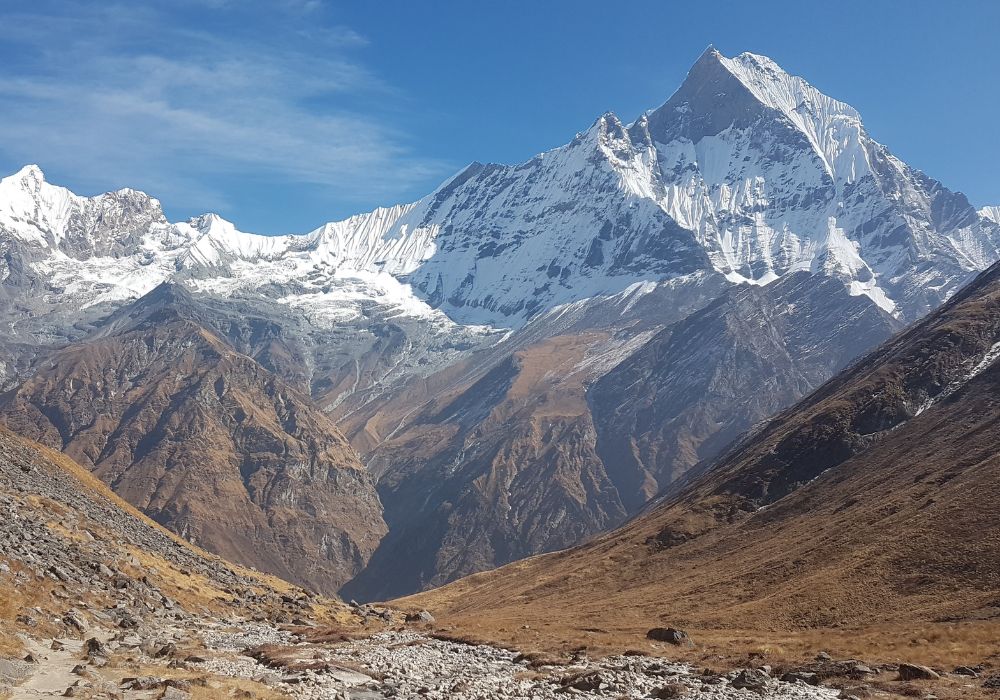
Is the Annapurna Base Camp trek difficult? For most reasonably fit hikers, it is a moderately challenging to strenuous Himalayan trek, depending on their route, pace, prior walking experience and the season. You do not need ropes or technical mountaineering skills on the standard trail in suitable conditions, but the trek is not an easy walk. Several days of steep stone steps, uneven ground and uphill hiking lead to Annapurna Base Camp at approximately 4,130 meters (13,550 feet).
Use our 10-day Annapurna Base Camp trek itinerary to check the daily walking stages against your preparation. The ten days include Kathmandu and Pokhara arrangements; six days are spent trekking, so this remains a compact mountain schedule. The 6-day trek from Pokhara is an alternative for travelers already there, while the 12-day route via Ghorepani and Poon Hill adds different walking stages. Choose by daily effort, overnight elevations and available flexibility, rather than total trip days alone.
Quick difficulty answer: Plan for roughly 4–7 hours of walking on many trekking days, with occasional longer or slower days. Expect sustained ascents and knee-testing descents, especially around Chhomrong and on the Ghorepani approach if you choose it. ABC reaches 4,130m, so altitude illness is possible even for a strong trekker. The short 6-day itinerary is better suited to well-prepared walkers who understand its faster ascent and limited time buffer. The route and conditions matter more than any single “easy” or “moderate” label.
Annapurna Base Camp Trek Difficulty at a Glance
| Difficulty factor | Practical assessment |
|---|---|
| Overall difficulty | Moderate to challenging for reasonably fit trekkers; potentially strenuous for first-timers |
| Maximum elevation | Annapurna Base Camp, approximately 4,130m |
| Technical climbing | Not required on the ordinary trekking route in suitable conditions |
| Typical walking time | Often about 4–7 hours on trekking days, with some longer days possible |
| Major physical challenge | Repeated stone-stair climbs and steep descents |
| Main altitude challenge | Rapid gain through the upper sanctuary, especially on compressed itineraries |
| Higher exposure and weather | Deurali–Machhapuchhre Base Camp–ABC approach, subject to snow, ice and avalanche or falling-debris conditions |
| Shorter option | 6 days Pokhara–Pokhara, with little margin for acclimatization or delays |
| Longer option | 12 days Kathmandu–Kathmandu via Ghorepani, Poon Hill and Tadapani |
| Beginner suitability | Possible with good preparation and a realistic itinerary; not appropriate for every beginner |
What Makes the ABC Trek Hard?
Four things account for most of the challenge: steep climbs, long descents, high-altitude exposure and mountain conditions. Some days in the lower hills feel like an endless series of staircases rather than a gentle path. Higher up, the air is thinner and the trail can be wet, rocky or snowy. Carrying a small daypack helps, but the walking still requires steady endurance and balance.
People sometimes compare ABC with walking in a city park because there are tea houses throughout the region. Teahouses make logistics easier, but they do not remove slippery paths, poor weather or altitude risk. You also cannot rely on finding a lodge every time you feel tired: accommodation and trail conditions become more limited as the sanctuary narrows.
Which Sections of the Annapurna Trail Are Most Difficult?
1. Chhomrong stone steps and the descent into the valley
The approach through Chhomrong is memorable because you often descend sharply before climbing again toward Sinuwa. These repeated changes in elevation can be harder on the knees than an even uphill path. Trekking poles, secure footwear and a consistent pace make a noticeable difference. Returning by the same valley means some steps you descended on the way up will become climbs on the way back.
2. The Ulleri stairs — only on the Ghorepani approach
Older ABC guides often say every trek begins at Nayapul and includes thousands of steps through Ulleri. That describes a traditional approach, but it is not true for every present-day ABC itinerary. Amigo’s 12-day ABC route uses the Ulleri–Ghorepani–Poon Hill approach, with repeated steep steps and a more varied approach. Our direct 6-day trek and 10-day trek instead use road access toward Ghandruk or the Jhinu area, subject to road conditions. They avoid the Ghorepani detour but have a more compressed uphill schedule.
3. Deurali to Machhapuchhre Base Camp
Above Deurali, the route feels more alpine and exposed. Snow or ice, cold conditions, changing visibility and avalanche or falling-rock exposure can all change the difficulty significantly. The guide should check trail conditions and local warnings before crossing vulnerable sections. Never treat an avalanche-prone passage as safe merely because it appears in the published itinerary. Turning around or waiting is sometimes the correct choice.
4. The final climb to Annapurna Base Camp
The final ascent toward ABC is not technical climbing, but at around 4,000 meters even a moderate slope can feel harder than expected. Walk at a sustainable pace, keep warm, and communicate any headache, dizziness, nausea or unusual fatigue. The best viewpoint is not worth pressing onward with worsening symptoms or unsafe weather.

ABC Difficulty: 6 Days vs 10 Days vs 12 Days
| Amigo itinerary | Route and pace | Who should consider it |
|---|---|---|
| 6-day trek from Pokhara | Five main trekking days with a rapid ascent from the Ghandruk/Jhinu approach to ABC; the final day returns to Pokhara | Hikers with good endurance, realistic expectations and preferably prior high-altitude exposure |
| 10-day trek from Kathmandu | Six trekking days with Kathmandu and Pokhara logistics built in; direct sanctuary approach without Ghorepani/Poon Hill | Fit beginners and regular walkers who can manage long steps and fairly rapid upper ascent |
| 12-day trek from Kathmandu | Longer route through Ulleri, Ghorepani, Poon Hill and Tadapani before the sanctuary | Walkers who want broader scenery and more trekking days, and are prepared for the extra climbing and distance |
All three published options reach approximately 4,130m. The trip duration includes non-trekking days, so never compare difficulty by total holiday length alone. The slower-looking 12-day program covers more ground because of Poon Hill; it is not an automatic guarantee of full acclimatization. A specific altitude itinerary still needs to be evaluated using overnight elevations, not just total days. If you have concerns about altitude, we can discuss adding a suitable extra night rather than simply choosing the longest headline duration.
How Difficult Is the Altitude at 4,130m?
Annapurna Base Camp is lower than Everest Base Camp, but 4,130m is still serious altitude. Thin air means you may breathe faster and feel slower when climbing. More importantly, even fit hikers can develop acute mountain sickness. Fitness improves how well you handle stairs and walking hours; it does not protect you from altitude illness.
The CDC Yellow Book’s 2026 altitude guidance recommends gradual ascent and, when feasible, limiting increases in sleeping elevation above 3,000m to around 500m per day, with additional acclimatization time for further gain. ABC itineraries can involve more rapid elevation changes, especially near the sanctuary and on short departures. Those recommendations are a reason to discuss the actual overnight schedule with Amigo, not to assume every standard itinerary meets the ideal sleeping-elevation limits.
- Tell your guide promptly about a headache, nausea, dizziness, loss of appetite or unusual tiredness that appears at altitude.
- Do not continue upward to sleep higher while you have possible altitude-illness symptoms; get advice and allow assessment.
- If symptoms worsen despite rest, descend and seek medical care. Severe breathlessness at rest, confusion or poor coordination requires urgent action.
- Do not rely on an oximeter reading, medication, personal fitness or the availability of helicopter rescue as a guarantee of safety.
- Speak with a travel-medicine professional before departure if you have relevant medical conditions or a history of altitude problems.
The CDC’s Nepal travel-health guidance also distinguishes lower-elevation Annapurna treks from visits that reach significant altitude. The important factors are where you sleep, how quickly you go there and your individual response. Ask about a slower route if this is your first experience above 3,000m.
How Many Hours a Day Will You Walk?
Many ABC trekking days involve about 4–7 hours of walking, but this is only a useful planning range, not a promise. Rough trails, elevation gain, photography breaks, heavy rain or snow can make a day noticeably longer. Some descent days are taxing because of thousands of steps even when you are gradually losing altitude.
Distance alone is a poor predictor of difficulty in the Himalayas. A short section climbing steep stone steps can be more exhausting than a longer, level forest trail. Instead of planning a daily speed in kilometers, prepare for consecutive days of controlled, steady effort. Ask your guide about that day’s estimated ascent, descent, weather and next reliable rest stop.
Can a Beginner Complete the Annapurna Base Camp Trek?
Yes, some first-time Himalayan trekkers complete ABC with an experienced local guide, well-fitting equipment and realistic preparation. However, “beginner friendly” should never mean that everyone can attempt any itinerary without preparation. The 6-day version is particularly fast; for someone new to hiking or altitude it may be an unnecessarily difficult first high-altitude experience.
A traveler who regularly hikes for several hours, can climb and descend stairs comfortably and has practiced with a daypack may find the trail manageable in good conditions. Someone who rarely walks, has serious knee issues, struggles with uneven terrain or needs longer recovery between days should discuss adaptations or a gentler trek. A medical assessment may be appropriate for individual health conditions, especially where high altitude is involved.
A guided trip can provide planning and logistical support, not a guarantee of reaching base camp. The guide should be able to adjust the day plan, arrange safer alternatives where possible and recommend stopping when necessary.
How to Train for ABC: A Practical 8-Week Plan
| Preparation period | Main goal | Practical exercises |
|---|---|---|
| Weeks 1–2 | Build an aerobic base | 3–4 brisk walks each week, plus comfortable stair sessions and basic mobility work |
| Weeks 3–4 | Strengthen climbing and descending | Longer hill walks, controlled step-ups, squats or lunges as appropriate, and regular recovery days |
| Weeks 5–6 | Practice longer mountain days | One progressively longer walk each week with a light daypack, plus 2 shorter workouts |
| Week 7 | Rehearse consecutive-day effort | Back-to-back moderate hikes if your fitness allows; test boots, poles, socks and layering |
| Week 8 | Reduce fatigue before departure | Shorter easy walks, maintain mobility, check equipment and arrive rested |
This is a flexible example, not a medical prescription. Adjust the effort for your starting fitness, age, injuries and available time. Avoid suddenly increasing the duration or intensity of exercise if you are not used to it. If you have knee pain, work on controlled downhill walking and consider professional advice; downhill loading is a major issue for some ABC trekkers.
How Does the Season Change the Difficulty?
| Season | What changes for trekkers |
|---|---|
| Spring: March–May | Often a practical trekking period; wet or snowy conditions remain possible near ABC |
| Autumn: October–November | Often good views and popular trail conditions; colder nights and crowded teahouses are possible |
| Winter: December–February | Snow, ice, extreme cold and increased concern about exposed mountain sections |
| Monsoon: June–September | Wet steps, leeches lower down, landslides, cloud and possible road or trail disruption |
The biggest difficulty change is not just rain or cold but whether mountain conditions make a passage safe at all. The upper sanctuary deserves particular caution after snowfall or during unstable conditions. Even a strong, experienced walker should follow a guide’s risk assessment and change or abandon the plan if necessary. Avoid any headline claim that ABC is safe to trek year-round in all weather.
Equipment That Makes the Difficult Sections Easier
- Broken-in hiking boots with reliable grip and appropriate socks; avoid starting in brand-new boots.
- Trekking poles for steep stairs, especially on long descents if they suit your walking technique.
- Layering for exertion and cold stops: moisture-wicking base layers, warm mid-layer, insulated jacket and waterproof shell.
- A manageable daypack with drinking water, snacks, headlamp, sun protection and personal medications.
- Warm hat and gloves for high elevations, and additional winter traction equipment only if your guide advises it for the actual conditions.
- Suitable sleeping arrangements and warm clothes for teahouses where private rooms and hot showers may be limited.
Amigo’s published ABC packages include guide and porter support, with generally one porter per two trekkers. Porters reduce the weight you carry, but hikers still need the fitness to move themselves up and down the route. See our ABC useful-information guide for fuller equipment, teahouse and insurance details.
Is Annapurna Base Camp Easier Than Everest Base Camp?
ABC is typically shorter and reaches a lower maximum elevation than the standard Everest Base Camp journey, so many trekkers consider it a less demanding overall commitment. But the lower altitude does not erase risk, and ABC has its own hard sections: steep Chhomrong steps, significant descents, possible snow hazards on the upper trail and fast ascent options. A poor match between itinerary and fitness can make either trek difficult.
The comparison should focus on your experience, time available, expected overnight elevations and willingness to adapt. Do not choose ABC just because it is described as easy in older blog posts.
Do You Need a Guide and Permits?
The Nepal Tourism Board’s revised TIMS guidance lists the Poon Hill–ABC trek among the routes covered by its licensed-guide and trekking-agency TIMS requirements. The exact paperwork can depend on the chosen approach, and conservation-area entry requirements also apply. The current Amigo ABC trekking packages list the required permits, licensed guide and porter support in their inclusions. This does not change the physical grade, but it makes trip planning and communication clearer.
Our Annapurna Base Camp trek cost guide covers the specific permit and package-price breakdown. For a complete trip overview rather than a difficulty assessment, see the ABC trek guide or first-timer’s Annapurna Base Camp guide.
Annapurna Base Camp Trek Difficulty FAQs
How difficult is the Annapurna Base Camp trek?
Moderately challenging to strenuous depending on route, fitness, season and acclimatization. The normal trail is non-technical, but its steep stairs, repeated climbs and height of 4,130m require preparation.
Is Annapurna Base Camp suitable for beginners?
Some well-prepared beginners can complete a suitably paced guided itinerary. Beginners with little hiking experience should avoid assuming the 6-day route is easier simply because it is shorter.
What is the highest altitude on the ABC trek?
Annapurna Base Camp is approximately 4,130 meters above sea level. The standard trek does not involve climbing Annapurna I.
How many hours do you trek each day?
Many days involve roughly 4–7 hours of walking, sometimes more depending on elevation gain, conditions and the actual route.
Are the Ulleri stairs included in all ABC itineraries?
No. The Ulleri–Ghorepani approach is included in Amigo’s longer 12-day itinerary, but the direct 6- and 10-day approaches use the Ghandruk or Jhinu side, depending on the route and road conditions.
Which is harder, 6-day or 12-day Annapurna Base Camp?
The 6-day trek compresses walking and altitude gain, whereas the 12-day route includes more trekking and the Ghorepani/Poon Hill section. Each is difficult for different reasons.
How hard is the climb from Deurali to ABC?
Thin air, uphill walking and potential snow or unstable mountain conditions can make it demanding. Follow the guide’s assessment of the Deurali–MBC–ABC corridor.
Do I need climbing equipment or technical experience?
Not for the normal ABC trekking route in suitable conditions. It is not a technical climb; specialized winter traction equipment may be needed if advised by a professional guide.
Can I get altitude sickness at Annapurna Base Camp?
Yes. At 4,130m, altitude illness is possible even for fit hikers. Gradual sleeping-altitude gain, recognizing symptoms and being willing to descend are important.
Is the ABC trek hard on the knees?
It can be, particularly on long descents and stone stairs near Chhomrong or on the Ulleri side. Training with controlled descents and using poles where helpful can reduce strain.
How fit should I be for Annapurna Base Camp?
Ideally, you should be comfortable walking on uneven hills for several hours on consecutive days, including stairs while carrying a small daypack.
How long should I train before the trek?
About 8–12 weeks is useful for many people starting with reasonable fitness; people with less hiking experience may need longer and should increase training gradually.
Is Annapurna Base Camp more difficult in winter?
Often yes. Snow, ice, cold and avalanche risk on exposed sections may make the upper route difficult or unsafe, regardless of personal fitness.
Can children or older trekkers do ABC?
It depends on individual fitness, health, altitude response, trail conditions and pacing. Discuss specific needs and an appropriate itinerary with a medical professional and the operator.
Will a porter make the trek easier?
A porter can reduce the load carried in your main bag, but you still walk the trail, ascend steep steps and handle altitude. Amigo generally includes one porter per two trekkers in its published ABC packages.
How does ABC compare with Everest Base Camp in difficulty?
ABC normally reaches a lower elevation and takes fewer days, but its steep stairs, fast ascent variants and seasonal hazards mean it should not be described as risk-free or effortless.
Choose an ABC Trek That Matches Your Fitness
The best plan is not automatically the fastest or the cheapest. Tell Amigo Treks & Expedition how often you hike, how you feel on steep descents, whether you’ve slept above 3,000m before and how many days you can allow. We can explain which itinerary fits your experience and where extra time may be valuable.
Compare the 6-day trek from Pokhara, 10-day Short Annapurna Base Camp Trek and 12-day Annapurna Base Camp Trek via Ghorepani. The aim is to arrive prepared, enjoy the trail and make sensible decisions about altitude and weather—not to promise a guaranteed summit-style achievement.



Yes, Annapurna Base Camp Trek is no too difficult trek. It is moderate level trek that anyone can do it. Basically you need to walk slow, drink plenty of water, eat hygienic food, keep warm and enough acclimatize before reach ultimate destination.
It is always suggested to do this Guide who is experienced with the region and can speak good english so that you can have cultural tips to get to know the people and more.
So plan your next adventure to Nepal and do Annapurna base Camp. You can do it.
Yes i agree. It is a bit physically demanding but not serious climbing. What you need is to have strong determination. That’s it. Other than that proper equipment as per the travel season in Nepal, climb slow and eat & drink good and plenty food is the most.
I have done it last year with Amigo Trekking team and it was just fantastic. My guide was really professional and can’t explain him high enough. Thank you Amigo team and hope to do Everest base camp trek with your guys.
Finally i would say hire a guide and take your time to do it. No rush. You will reach there without problem.
Hello! Would you mind sharing some details of your trek? I am thinking of doing it this July. It’ll be the monsoon but some say the Annapurna Base Camp is sheltered from the monsoon. Is this true? I intend to spend 8-10 days. What was your itinerary? Also, how do I contact Amigo Trekking?
please email us at info@amigotrekking.com
Hello! I haven’t been on the trek yet. In fact we have decided to go in Dec instead. I believe it is the Annapurna Circuit that’s sheltered, not ABC, and we don’t have enough time to do the circuit. The agent we are dealing with advised against trekking in July. Apparently visibility can be poor and leeches a problem, aside from the fact that there could be major landslides during those monsoon months. We are doing the Khopra Dhanda trek (also in Annapurna), which is relatively new and seems like a dream. Check it out! Let me know if you need any other info.
Sorry, the above is meant for another website.